Friday, June 13, 2014

Operation Harvest Timeline of Events


Taken from John, Maguire's book, "IRA Internments." GRMA 
to Mick Healy. 


Wednesday, May 14, 2014

The IRA Volunteers of the 50's

  THE  IRA  VOLUNTEERS  OF  THE  1950s


(From Saoirse, "50 Years Ago Today")
http://www.iol.ie/~saoirse/2002/dec02/50yrsago.htm


"DESPITE the IRA's ties to Sinn Féin, the Volunteers of the 1950's were non-political. They wanted to end partition, abolish the border, unite Ireland."
Thus Seán Cronin in his Washington's Irish Policy 1916-1986 described the members of the new generation who joined the IRA. He went on: "Their predecessors in the 1940s, the 1930s and the 1920s wanted to establish 'the Republic'. Of course the 26-County republic had been inaugurated in 1949 and this caused confusion regarding the word 'republic'."

"They were recruited more or less openly, they trained more or less openly, they attended summer camps in the Wicklow mountains," Cronin continues. The writer took part in those training exercises and would contend that while the Special Branch often became aware of and observed the very large training camps at a distance, training was conducted discreetly and covertly.
Land and buildings were generally used with the consent of the owners or occupiers and local people who came by chance upon classes or exercises did not report them to the police. Training was not conducted as openly as in 1914-16 or the 1932-34 period.

Cronin goes on:  "Like the 1914 Irish Volunteers, they saw themselves doing national work. And they enjoyed a degree of tolerance and support because of the anti-partition campaign and the Ireland Act (1949)."

He sketches the background very ably and quotes a report to Washington from the US Legation in Dublin entitled Possibility of Resort to Arms Over Partition of Ireland; Organisations Advocating Use of Force, and dated September 16, 1949. There was no mention in that title of "violence" or "terrorism", mark well.

The report ends: "As in the case of all other nationalist organisations the British 'Ireland Bill' of 1949, was cause for an intensification of the IRA programme.

"The IRA contends that the world at large will not take cognisance of partition until it develops into an armed conflict of international proportions. The cardinal point of its constitution is that partition must be abolished by force of arms if necessary."

Cronin comments; 'The 1949 Act closed all doors to peaceful change , unless the Unionists underwent a miraculous conversion to the political theory of Irish Nationalism.

"As in 1914, young Nationalists, North and South began to examine, at least, the physical force alternative. As the (US) Legation noted a number of times, one of the examples cited was the creation of Israel. The British left Palestine because they were forced out.

"In 1949, the IRA was little more than a bogy (sic) to mobilise Unionist voters in the North. Except for a small minority, most Republicans of the 1930's and 1940s supported Clann na Poblachta.

"Although many grew disillusioned when McBride joined the [Coalition] government, they were willing to give him a chance to end partition through dialogue and negotiation.

"Northern Nationalists were willing to wait until world opinion, meaning America, made the Unionists and the British see reason. They believed time was on their side. Conditions were better in the North than in the South. They were in no hurry, partition could not last.

"By the summer of 1949 Northern Nationalists began to realise that the British had no intention of talking about partition, let alone ending it. The optimism generated by Costello and McBride had no foundation.

"Many believed that the British government had deliberately ignored the opportunity of solving the problem peacefully, an opportunity that might not come again.

"If this thing is done to our country, I say for myself that then feelings will be back to what they were in 1919 to 1921', de Valera said of the Ireland Bill when he heard of it. 'If these people are to tell us that our country can only be united by setting us an impossible task, we hope another way will be found that will not be impossible. We had hoped for something different than that."

Cronin was quoting de Valera from the Irish Press of May 2, 1949. He wondered: "What did this mean? It could mean that, as in 1919 to 1921, the use of force in defence of right was inevitable. In those 'glorious years', as the romantics had it, the Irish fought for independence rather than pleaded for Home Rule. Some members of Fianna Fáil advocated force in the summer of 1949.

"The IRA, as the Legation analyst noted, was the natural repository of the physical force tradition. But Fianna Fáil in the 1940s had done its work well, with some help from the IRA. The organisation was practically wiped out in the South.

"If the membership of the IRB in 1912 could have seated comfortably in a concert hall, the IRA in 1949 would have managed quite well in a school classroom.

"A call to arms against the Ireland Act would have mustered a platoon at best. There was little reality behind talk of force in the Northern Ireland of 1949.

"Between 1949 and May 1951, the IRA was caught up in its own internal wrangles and purges, all having to do with its future course.

"From these emerged Tony Magan as Chief-of-Staff who 'wanted to create a new Army, untarnished by the dissent and scandals of the previous decade', as J. Bowyer Bell put it, with 'no shadow of a gangster gunman, no taint of Communisn, but a band of Volunteers solely dedicated to reuniting Ireland by physical force".

"The recruits of the IRA in the 1950s came out of the anti-partition agitation against the Ireland Act. They were young idealists, much like the Irish Volunteers of 1914."

There follows the paragraphs quoted at the outset of this article. With regard to the charge that the Volunteers were "non-political" despite the IRA's ties to Sinn Féin, it depends what is meant by "political".

In general the recruits were of course nationally minded and wanted Irish control and native development of Ireland's natural resources. They were mainly working-class in the cities and towns and their interests and attitudes would reflect this.

In rural areas they were from the small farm countryside. Culturally many were attached to Conradh na Gaeilge and or the GAA as one would expect. They were certainly left of centre and would have strongly supported "equal rights and equal opportunities" for all citizens as stated in the 1916 Proclamation.

A few were third level students, teachers, civil servants or local council officials and many " but not all " were members of Sinn Féin. This latter and involvement in the Westminster elections North of the Border, and local and parliamentary contests South of it inevitably sharpened their politicisation.

A third-level student, Frank Gogarty - later of the Six-County Civil Rights Association "had some verse carried in the December 1952 issue of An tÉireannach Aontaithe/The United Irishman. It appeared under his usual non-de-plume 'P Mac Giolla Chroim'.

On Reading of the Capture of Arms from an English Military Post was the title and it read:

"Some, with bitter words will say
Their acts were all a folly and they
Who dared it were wanton youth
Distracted by a creed uncouth
And unworthy of these latter days.
This they will say, and go to tell the praise
Of shameless men who stain
A nation's glory for political gain,
They, who with cunning word and wit befool,
And foster still the alien rule.

"But their evil power must pass and their exalted fame
Be remembered only with shame.
Forgotten will be their little days
Of glory when men will learn to praise
Today's outlawed deed, and honour the youth
Who strove for the single truth
That their nation's honour must be rewon

And by the way of Pearse and Tone.
'Tis these I praise, the youthful few
Mindful of their hallowed trust, and true
To the splendid heritage of Things
That love and lore to battle brings.

Surely they love their country well who dare
Forage even in the enemy's lair!
"May they learn, these few brave men
Be they in city streets, or rocky glen,
Or live in valley, plain or wood:
May they learn of the gratitude
They win in hearts as mine;
May they know our joy, and our pride in them
Bringing glory back to our country again.

"What, though the selfish say
Their act were all a folly! We rejoice that they
Who dared it are the best of Ireland's youth,
Soldiers, fearless in the truth
That their country's honour can and will be won,
By one way only - the way of Pearse and Tone."
-- Mac Giolla Chroim

Well said, Frank Gogarty. Beannacht Dé led anam calma.


(More next month. Refs. Washington's Irish Policy 1916-1986: Independence, Partition, Neutrality by Seán Cronin, published 1987 by Anvil press, Dublin and An tÉireannach Aontaithe/The United Irishman, December 1952.) http://www.iol.ie/~saoirse/2002/dec02/50yrsago.htm

http://www.iol.ie/~saoirse/2002/dec02/50yrsago.htm

IRA Easter Statement, 1955

 IRA Easter Statement, 1955
(From Saoirse "50 Years Ago Today")

“The primary object of the Irish Republican Army is to secure the complete liberation of our country from British aggression, by arming and training the manhood of Ireland to prosecute a full-scale military campaign against the British forces of occupation.

“Under no circumstances will the leadership of the Army allow any deviation from this objective. Under no circumstances will it allow the young men, banded together to fight the traditional enemy of our country, to be drawn into any struggle or controversy which would absorb the energy needed to attain the primary objective of the Army.

“There would appear to be misconceptions in the minds of many people regarding the constitution and control of the Irish Republican Army. In view of the Army Council considers it advisable, in this statement, to emphasise the following points.

“1. The Irish Republican Army is a voluntary organisation and is not bound by oath. The Declaration which all Volunteers are required to make is a simple one, promising to promote the objects of Óglaigh na hÉireann and to obey the orders of their superior officers.

“2. The Irish Republican Army is not a secret organisation. The very fact that, all over Ireland, units of the Army are parading publicly to honour their dead on this Easter Day is sufficient refutation of this charge.

“The Constitution of the Army, which provides for a General Army Convention every year, at which the elected delegates from all the Units in Ireland come together for the purpose of deciding policy and electing the Army control for the ensuing year, is a good safeguard against any person or group using the Army for an unworthy purpose.

    “3. Since the whole membership of the Irish Republican Army is composed of men who serve neither King nor Kremlin, but Ireland only, there is a very rigid check kept on subversive individuals or groups who might try to gain membership of the Army and turn the efforts of the young men pledged to fight for Ireland to some other and less worthy object.

“Further clarification of these and other points may be obtained through reading the Constitution of Óglaigh na hÉireann, which is on sale to the public.

    “It now remains for theArmy Council to place before the young men of Ireland the ideal of service, and to point out to them that the issue is now clearer than ever – Ireland and Ireland’s right to freedom, against England and England’s Army of Occupation.

     “In the military operations against the British garrison in Omagh some months ago, eight soldiers of the Irish Republican Army were captured and subsequently charged with ‘Treason-felony’. On the field of battle and at their trial they proved themselves worthy representatives of a Movement which has always drawn its adherents from our bravest and best . . .

     “The real traitors are those who, calling themselves Irishmen, are prepared to accept office from an alien government, and who may be called upon, in the course of their service, to sit in judgement on their fellow Irishmen and sentence them to death or imprisonment for fighting for Ireland’s freedom.”

"The hour of decision is at hand for every man and woman in Ireland, and the trained, armed, disciplined and resolute soldiers of the Irish Republican Army, ready to do battle, look forward with quiet confidence to the future and hope that the young men of this generation will accomplish the task bequeathed to them by those whom we honour today, and make Ireland free at last from foreign oppression.”

Tuesday, May 13, 2014

Vol. Leo McCormack

 (I'd be interested if anyone could help complete this bio- GRMA)


    Leo McCormack (sometimes spelled McCormick) was one of several military-trained volunteers whose expertise contributed greatly to the level of skill in the newly organized IRA of the early 50's.
    He was born in Dublin but emigrated to England like many young Irishmen of his day. There he joined both the British Communist party and enlisted in the Commandos. On account of the latter, when he returned to Dublin and joined the IRA, he became training officer for the brigade and quickly made the GHQ staff.  He was unemployed and is said to have had "no prospect" of getting a job, either from his politics or the economic climate or both. For this reasonTony Magan appointed him as a full-time organizer; a position in which he would travel the country on a small pension from the movement and the charity of local supporters, organizing, training, and coordinating local units. In 1953, while making a tour of the 6 counties, he discovered the sentry at Gough Barracks was unarmed, which led to the famous raid in 1954. By the time the raid happened however, he was serving a four year sentence in Crumlin Road Jail for "possession of documents." He had served out his sentence when Operation Harvest began, but the state decided to intern him for the duration of the campaign. While in jail he earned a degree in accounting. He was released in 1962 and had no further involvement in the movement.

Monday, May 12, 2014

"Fellow Irishmen:" The B-Specials and the IRA in the 1950's

"Fellow Irishmen:" The B-Specials and the IRA in the 50's
  By Miceal


"If to have striven to make my fellow-men love each other was guilt, then I am guilty." -Bartholomew Teeling


THE B-SPECIALS

   Founded in 1922, the B-Specials were an all-protestant, para-police force. In the mid 50's, their membership counted 1,000 full time, and over 11,000 part time.(1)
   Their standard duty, especially in rural areas, was manning roadblocks but whenever there was an "incident" -a raid, an escape, a shooting- the B Specials would perform sweeps of the surrounding countryside and homes, usually in support of the RUC and Army. The fact they were usually locally recruited gave them a significant edge over the mostly southern-born IRA volunteers and made them a vital part of any British search party or cordon. "The B Specials were the rock on which any mass movement by the IRA in the North has inevitably floundered" wrote Tim Pat Coogan. (2)
   The Specials, however, were complicated by the fact most were ordinary workers by day- many, in fact, commuted from the south as a sort of night job in Ireland's depressed economy. Says one writer, "the Protestant hill farmers (in her area) who shared farming tasks with catholic neighbors and related to them as equals were almost all members of the b-specials."(3) But once in uniform they displayed a Jeckyll and Hyde-like persona swing. "A lot of fellows I knew during the day were out at night as Specials manning road blocks and pretending the didn't know me," recalls Seamus Heany. "I knew that had I been an equally innocent protestant I would have been allowed to pass without any bother."(4).
    Seamus Graham remembers growing up with the Specials in Belfast:
     "(It was) about 1957, the IRA’s Border Campaign was raging and armed “B” Specials ...could be seen on the streets of Belfast amidst an uneasy air. As we came out of the cinema there were two “B” Specials standing outside, as we passed them in the ignoring way that was second nature to Catholic kids, they called on us to halt. They asked us our names and addresses and on hearing the Ardoyne address’s began treating us as ‘the enemy’. Here we were, typical young lads being grilled for no reason other than we were Catholics, they were letting us know who were the bosses in the six counties.....It is an historical fact that they were not the brightest and cowardly into the bargain, during their existence thirty of them either accidentally shot each other, or themselves, dead and they cost the old “Northern Ireland” (Six Counties) government a fortune for the claims made by farmers who woke up in the mornings to find their cows and sheep shot in the fields. These Ulster warriors were not the brightest yet they were turned loose on the streets armed to the teeth, to ‘Keep the Fenian’s in their place’." (5)
    "Keeping the fenians in their place" often took the form of vicious assaults on even marginally nationalist events, like NCA races or St Patrick's Day Parades. During the 1952 St Patrick's Day parade in Derry a photographer captured an image of a B-man's baton about to fall on a 6 year old girl, but nearly no newspapers would carry it. "It was then I felt," says one Derry man, "that there was no chance of having the injustice of the Protestant sectarian state or its militant and paramilitary apparatus exposed."(6) Any event displaying the banned Tricolor- or something resembling it, as the Kerry team of the Ras Tailteann learned one year- was singled out for attack. In addition to their security duties, they were effectively the state's shock troops against the nationalist population.
     Sean Cronin, in his pamphlet "Resistance," observes "(they) lack the discipline of an army" and that "it takes little enough incitement to set (them) on a rampage." Indeed, there is a lengthy list of people murdered or wounded for life by the B Specials.
     The following covers just a 2 year period, and does not include those injured in other situations, like baton charges:

"March 5, 1955: Eighteen year old Arthur Leonard was shot dead by a B-Special patrol between Keady and Darkley, County Armagh. He was driving a van at the time. His companion, 16-year-old Clare Mallon, was seriously wounded.

March 6, 1955: Austin Stinson, a 23-year-old native of Derrygonnelly, County Fermanagh, was seriously wounded by a patrol of B-men on the Aughnacloy-Augher road while driving a car.*

October, 1955: Thomas Corrigan (33) of Ann Street, Dungannon, was, in his own words, “brutally attacked by a party of armed B- Specials on the outskirts of Dungannon.” He received medical treatment to his head, arms and legs.

October, 1955: A B-Special Constable, Daniel Richmond (26), was shot dead while drilling with other Specials at Park Hall, Armoy, County Antrim.

December 26, 1956: Charles Hilliard (38) of Brackley, Ederney, County Fermanagh, was wounded in the leg by a B-Special patrol while driving home early in the morning.

January 1, 1957: Five young Tyrone people were fired on by B- Specials as they drove home from a New Year’s party, near Caledon. Una Buchanan (12) lost the sight of an eye. Maurice Buchanan (19) was seriously wounded in the back. Florence Buchanan (14) and Ruby Buchanan (17) had hand injuries. Mervyn Mulligan was wounded in the arm.

January, 1957: A B-Special shot his own son as the latter approached a road-block between Dungannon and Coalisland, Co. Tyrone.

February 1, 1957: Special Constable Kenneth Elliott of Newtownbutler, County Fermanagh, was motor cycling near his home at 8.15 p.m. when he was fired on by a police patrol and received serious abdominal injuries.

April 8, 1957: Special Constable Robert Henderson (24) was shot dead in the day room of Trillick Barracks, County Tyrone, by another B-Special.

June 9, 1957: Mrs. Margaret Martin (42) of Belfast, was wounded in the shoulder when a mixed B-Special R.U.C. patrol opened fire with Sten guns on her husband’s car near Killeen Customs Post, County Armagh. Subsequently it was established she will be paralysed for life.

June 5, 1957: A B-Special patrol fired on the car of Mr. James Hay, Strabane on the Swatragh-Maghera road.

July, 1957 : Special Constable Joseph Ewing (21). Cullybackey, County Antrim, received a bullet wound in his leg when an automatic weapon was discharged while he was on duty on the Dungannon-Moy road.

August 14, 1957: Robert Brown (25), Crossgar, County Down, was shot dead by a member of the Ulster Special Constabulary on the Kilmore-Crossgar road.

September 21, 1957: While motoring home at about midnight, Kevin John MacManus (35), of Lisnaskea. County Fermanagh, was seriously wounded after being fired on by a B-Special patrol.

 November 13, 1957: John Collins (45) a motorist ot Clanrye Avenue, Newry, was wounded about the head after being fired on by a B-Special patrol on the Armagh-Newry Road at 9.30 p.m." (7)


 REPUBLICAN RESPONSE

   The IRA's response to all this was disciplined and mindful of the responsibility they carried. Attacking the specials in turn would have been natural under the circumstances but to the Republican Movement it was more important to prevent the sectarian warfare that could ensue between the Unionist and Nationalist/Catholic populations. The bloody events of the 20's in the North - in which the B Specials played a prominent role- were still very much in memory.
   The IRA's statement on the opening of the campaign called for the Specials to step aside or resign, stating "the struggle...is most certainly not against the Unionist population of the 6 counties... The the members of the RUC and B Special Constabulary...We ask them to remember they are Irishmen."(8) Volunteers were further cautioned to limit attacks on the RUC, and outright forbidden to initiate attacks on B-Specials, in the event it would be construed as sectarian-motivated, or provoke such a reaction. "It was neither neccessary nor desireable to antagonize the unionists" writes Ruan O'Donnell in "From Vinegar Hill to Edentubber." (9) Thomas Mac Goilla, then a young member of Sinn Fein, explained that "they were seen as ordinary protestant people, mostly protestant workers, and very Irish, and we had no campaign against (protestants)." (10)
     Sean Cronin says the same in "Resistance": "Since the Resistance Movement recognises that the B-Specials are Irishmen who have been misled by sectarian and British propaganda, deliberate attacks on this body have not been part of its guerrilla policy up to now." The language of the movement and volunteers reflected this attitude. The 1955 Sinn Fein manifesto makes no mention of the "orange state" - only the British one, and says that sectarianism and bigotry have "no place in the movement." Statements from the dock by volunteers almost invariably emphasized that their arms were to be used solely against the British Army, and not against anyone from the Unionist community- being "fellow Irishmen". Joe Doyle: “These arms were to be used against the British Army of Occupation in Ireland." Even Sean Geraghty of the breakaway group in Dublin declared that "no Irishman or woman of any political persuasion has anything to fear from us." It would be tedious to list the many other statements that affirmed this.
    An interesting example of these "fellow Irishmen" was seen in the case of James Crossan, a Sinn Fein organizer and former IRA intelligence officer, who was casually drinking with an off-duty B-man the night he was murdered by the RUC. The B-man in question later testified in favor of Crossan. An isolated incident, but indicative of the fluid relationship the IRA at the time sought to foster.
     When targets such as B-Special drill halls and posts were attacked it was timed specifically to avoid casualties (though a special was wounded in one such attack in early 57.) There were still running gun battles for the first two or three years of the campaign but the IRA was deprived of the very important factor of aggressive or preemptive action when faced with armed confrontation with them. They were further hampered as the campaign went on by the fact that specials were being used as fill-in security at Army and RUC sites, making it impossible to avoid them on operations. It was akin to "attempting to fight the cavalry while endeavoring to ignore the existence of the infantry." (11)
    It frustrated to no end the northerners, who had to deal with the Specials on a daily basis. Saor Uladh considered them targets from the outset, though like the IRA they sought to avoid casualties. The IRA O/c of Derry wrote that he was restraining his men but if given permission to attack, "no one will complain." Volunteers recall the local nationalist population saying the B-Specials were the ones they should be attacking, not the army, and saw little reason to give support as a result. This attitude weighed heavily on the abilities of the IRA, which depended on an enthusiastic and supportive population to create enough proverbial "water" for their "fish."
    In 1958 the IRA announced that B Specials would be considered targets. Still, few volunteers took advantage of this and the B Men emerged from the campaign with the fewest casualties of all involved.

THE END OF THE SPECIALS

    The IRA stuck to this non-aggressive policy throughout the 60's. During this time the volunteers helped and stewarded marches of the Civil Rights movement, one of whose demands was that the B-Specials disband. Violence by the Specials reached a feverish peak, culminating in the attack at Burntollet and Belfast pogrom of 1969. The non-violent force of Civil Rights movement was winning the day however. The Republican Movement's restrained and forward-thinking policy allowed the world to see "the naked sectarianism of the 'B' Specials" for what it was and after 50 years, the Specials were finally disbanded in 1969. "In terms of the civil rights struggle.... the disbandment of the 'B' Specials was regarded as a major victory. At the time the role of the new force, later called the UDR, was not clear and the sectarian nature of this group did not emerge until later. But some progress had been achieved." (12)

    The practical anti-sectarianism of the 50's volunteers has continued in different ways. Sean Cronin devoted the better part of his writings to anti-sectarianism and the example of the United Irishmen, Adjutant General Charlie Murphy became a trusted confidant of the loyalist leadership in later years, and the stand of many others from that generation against cross-community warfare is well known. In recent years there have been several events (organized by "ORM") where veterans of Op. Harvest talk to loyalist youth about their experiences. The response so far has been very positive; many enjoyed hearing about their life on the run and were unaware of the IRA's history before the modern "Troubles."

   In conclusion, the IRA's Border Campaign was not successful but their desire to avoid sectarian conflict was, and it is certain that they did not consider victory in the north to be worth compromising their beliefs or provoking violence between the communities.  
   Sectarian policing is still an urgent issue in the North. The struggle against sectarianism itself is an ongoing one with no clear victory point but the important matter is that an effort be made to end the blight.


*- Stinson was a B man himself and member of the Orange Order. His shooting is sometimes erroneously pinned on Saor Uladh.

 FOOTNOTES:
1. James Dingley, "The IRA."
2. Tim Pat Coogan, "The IRA."
3. Quoted in "Northern Ireland: A Comparative Analysis" by Frank Wright
4. Quoted in "Seamus Heany: the making of a modern poet" by Michael parker, pg 15
5. http://showmetheman.rushlightmagazine.com/chapterone.html
6. http://www.derryjournal.com/news/your-community/nostalgia/st-patrick-s-day-60-years-ago-1-2513430
7. All quotes by Sean Cronin are from "Resistance," made available online by the Connolly Youth Movement.
8. Quoted in "Inside the IRA: Dissident Republicans and the War for Legitimacy"
 by Andrew Sanders
9. Ruan O'Donnell, "From Vinegar Hill to Edentubber."
10. Quoted in "Official Republicanism" by Sean Swan.
11. Swan
12. http://cain.ulst.ac.uk/events/crights/nicra/nicra783.htm

Sunday, May 11, 2014

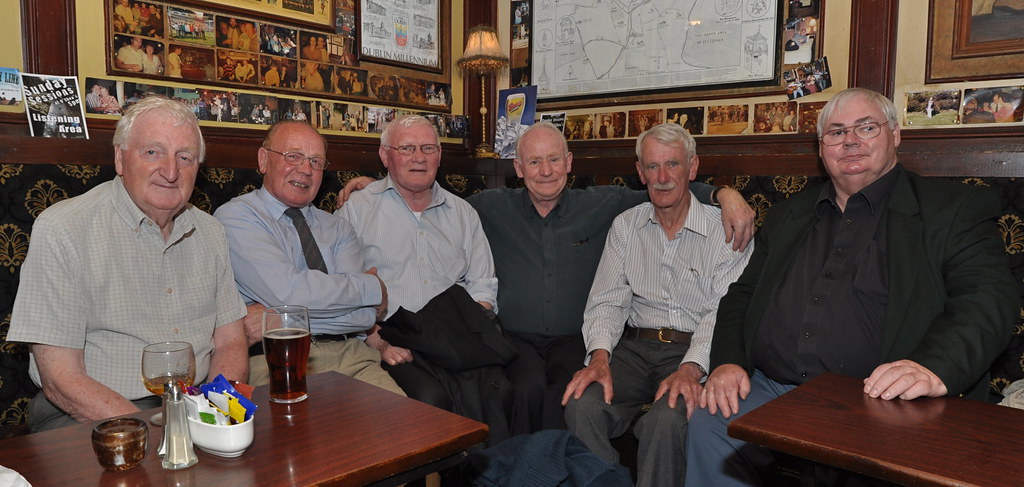
Pearse Column Veterans

 The surviving members of Pearse Column- veterans of the attack on Brookeborough Barracks (from 2010).
 Left to right: Michael O’Brien, Phil Donoghue, Sean Garland, Sean Scott,
Mickey Kelly, Paddy O’Regan
(GRMA to "thatman1")