Monday, January 4, 2021

Memoirs from the Cuban Revolution

                             Memoirs from the Cuban Revolution


"I do not wish that this fragmentary history, based on memories and a few hasty notes, should be regarded as a full account. On the contrary, I hope that those who lived through each event will further elaborate....There are many survivors of this battle and each of them is encouraged to fill out the story by contributing what they remember. I ask only that such a narrator be strictly truthful"

                                - Che Guevara, "Reminisces of the Cuban Revolution." 


     The Cuban revolution of 1959 is a textbook example of a successful revolution and the kind of underdog story everyone loves. It provided inspiration to fledgling nations like no event had in decades. "All our heroes were losers," Irish Republican leader Thomas Mac Giolla recalled later; "Che and Fidel were the first winners."(1)  Much ink has been spilled over the event, but polarization of academics along Cold War political lines renders impartial studies difficult to find, and there was unfortunately only scattered follow-up to Che's appeal for the rank and file to tell their story. (ie, there was no collection along the lines of the Irish Military History Bureau's collection of accounts from the 1916-23 period, or Cypriot Government's archive from EOKA members). But for all that, many participants did tell their stories. The following is a compendium of books by those who took an active part in the revolution as combatants, activists, or opponents. 

General Histories


 Two general histories by participants stand out: 
     Cuban Insurrection 1952-1959 by Ramon L. Bonachea is possibly the finest and most complete history, written in the tradition of Anthony Beevor or Alistair Horne.
    Bonachea has the historian's eye for what details to magnify and minimize when telling a story on a grand scale, and in this case it involves far more than the simple guerillas-in-the-jungle narrative. There is an alphabet soup of organizations, each with their own industrial strikes, actions, failed coups, political statements, and feuds, which Bonachea distills into a readable narrative. His status as a former revolutionary (he now lives in the US) gave him access to other former participants, enabling him to reconstruct otherwise unknowable background information to events, especially where minor players and organizations are concerned.
    The history is supplemented by charts illustrating battle plans and structure, making it a uniquely helpful stand-alone resource.

   Armando Hart wrote a history of the urban conflict in his book Aldabonazo: Inside the Cuban Revolutionary Underground, 1952–58.
     Aldabonazo (meaning a "knock on the door") is meant as a gap-filler, as most histories focus on the war in the countryside. The book tells of the activists in the cities ("llanos") who carried on their own conflict in sync with the guerillas in the mountains. The dominant figure is not Castro but Frank Pais, leader of the Llanos, who organized and directed urban unrest before his death in 1958.
     Hart writes with the cautious use of information, characteristic of underground men once responsible for others' lives, detailing strategy and ideology rather than nitty-gritty details of ambushes. He backs up his narrative with dozens of letters and documents.
    The one major drawback is that it is uncritical to the point of feeling artificial, and may not be as complete as it seems. In a telling passage he notes that some "were omitted from this history of glory" for having turned against the revolution afterwards. Many people receive a nod at some point in the book but several major players who later defected are unmentioned- one only wonders who, at ground level, was also written out.


Memoirs


   A good many personal accounts can be found in periodicals and newspapers (particularly the early issues of Granma), but there has been no concerted effort to collect accounts into a single, authoritative archive That aside, most major players in the conflict published memoirs.

    The starting point remains Che Guevera's Reminisces, both military history and a personal story. The prose that later elevated the Motorcycle Diaries to literary fame serves him well here. Like one iconic scene:

"A compañero dropped a box of ammunition at my feet. I pointed to it, and he answered me with an anguished expression, which I remember perfectly, and which seemed to say, 'It’s too late for ammunition.' He immediately took the path to the cane field. (He was later murdered by Batista’s henchmen.) This might have been the first time I was faced, literally, with the dilemma of choosing between my devotion to medicine and my duty as a revolutionary soldier. There, at my feet, was a backpack full of medicine and a box of ammunition. They were too heavy to carry both. I picked up the ammunition, leaving the medicine, and started to cross the clearing, heading for the cane field."

    Many things can be debated about Che's politics, but he is brutally honest on paper regarding war, and rarely digresses when discussing it. The book was studied by fighters in contemporary conflicts like Palestine, yet its focused realism turned out to be a pitfall for this audience as they were left uninformed of other key ingredients- like the urban movement and Castro's masterful PR - which were outside the scope of Guevera's experiences. "For him," Robert Oltuski writes, "the guerrilla forces in the Sierra Maestra were the reason for everything." The Reminisces is complimented by his Diary of a Combatant, the raw, unedited diary he kept during the revolution. There's no factual difference but the latter Diary chronicles day-to-day events which, like a microscope, shows life details a little more powerfully than his initial work. 

    Many people have written memoirs around Che and how they knew him. The most deserving of the accounts by former comrades is that of his second wife, Aleida Guevera March. A soldier in the July 26th Movement, Aleida met him while fighting in the Sierra Maestra. Her memoir Remembering Che is deeply felt and simply told, and as much a story of a woman at war as it is the titular subject. His first wife, Hilda Gadea, covered the early part of his career- meeting Castro, early days of training-  with remarkable honesty in My Life With Che. Gadea's intellectual background contrasts starkly to Aleida's simple style and she is more at terms with events.

    Castro wrote prolifically on the revolution, producing volumes of his prison letters, a two-part memoir, memories of Che, his youth, and numerous books of interviews with journalists. The most comprehensive of these is My Life: A Spoken Autobiography, an interview with Ignaciano Ramonet. This is the complete Castro: in the course of its 500 pages they discuss everything from his family background to his opinion of JFK and 911. The revolutionary days are covered in depth and take up the first half of the book.

    Batista wrote memoirs, entitled Cuba Betrayed, part memoir, part political statement. Simply comparing his autobiography to Castro's give some insight into the broader conflict: like his nemesis, Batista has an axe to grind and an array of views which are difficult to substantiate, but he suffers from not being able to make himself look interesting or heroic. There's little depth of feeling, no self-analysis, and quite a lot of finger pointing at everyone else for his loss of power. However, how a person views themselves is itself informative.


      Vida Clandestina  by Robert Oltuski is possibly the finest memoir after the Reminisces despite its novelized style. In his introduction Oltuski protests that he did not intent for this to be treated as a formal "history;" his intention was rather to present to younger readers what it was like to live through those times. Yet he surpasses the rest in his vivid descriptions of people, settings, and events. He describes the nitty-gritty of every day life as a "Llano"- from balancing work, love, and clandestine activities to the stains on his hands from newspaper-wrapped bombs. And although a fervent supporter of Castro, he makes no bones about disputes. He clashes with the movement on reform issues, calls out dead revolutionaries for incompetence, and credits those who later defected without questioning their commitment at the time of the revolution.
     (Of all the books on this list, I would recommend it to anyone who is new to the history of the revolution, or wants to read a heartfelt "war story" type account as opposed to an academic history.)

   Carlos Franqui played a crucial role before producing copious literature from exile. His Diary of the Cuban Revolution was groundbreaking when first published, and remains a standard reference for English-speaking students of the revolution (particularly for its information on left-wing opposition to Castro within the opposition.) He also wrote "The Twelve" detailing the early days of the revolution, Family Portrait with Fidel and others.

   Cuba and Castro by Teresa Casuso Morin tells a story of both adventure and intrigue, and heartbreak. Morin was a classic Cuban conspirator- a woman of mystery who dabbled in the arts while financing revolutions. She was heavily involved in the planning of the revolution, purchasing the Granma, and the training in Mexico but parted ways in the early 60's. She provides a detailed sense of place and writes with the weight of experience (she was involved with the 1930's revolution against Machado).

   Marianas in Combat by Teté Puebla and Mary-Alice Waters.  

 ""How can we give rifles to women when there are so many men who are unarmed?'”
 "Fidel answered: 'Because they´re better soldiers than you are.'"

  Tete Puebla joined the revolution in 1956 at the age of 15. She was a part of the all-female Mariana Grajales Women's Platoon. What it lacks in length, it makes up for in content. The book is framed through an interview between Puebla and Waters in which she tells her own story while exploring that of the Platoon. 

    The Cuba Story and Revolution In Cuba, by Herbert Matthews. A New York Times journalist, Matthews uncovered Castro when he was long believed to be dead, elevated him as a guerilla-hero, and the revolution quickly turned in the latter's favor afterwards. Its a Stanley and Livingston type story that should be a classic when told in Matthew's words; however the book is falls a little short of that as he struggles to vindicate his motives for supporting Castro in 1957 in light of events in 1960. Yet his memoir is a valuable view into a pivotal incident in Cuban history. Anthony DePalma told the story to critical and popular acclaim in The Man Who Invented Fidel: Castro, Cuba, and Herbert L. Matthews of the New York Times.

   Niell MaCaulay's A Rebel in Cuba (1970) is the autobiography of a Korean War veteran who joined the 26th of July Movement, one of the few to do so. His memoir is part boys-own adventure, part grisly realism a la The Things they Carried, and could take its place among classics were it not for the politics surrounding the experience (MacAulay himself is completely apolitical).

    Victor Dreke, From Escambre to the Congo. Dreke fought in the jungle during the later stages of the revolution. He later directed the counterinsurgency operations during the Escambray Rebellion (which MacAulay was running guns to) and oversaw Cuban expeditions abroad. The focus is on the latter events but the initial chapters talk about the revolution from the perspective of one of its most loyal cadres.

  The Unsuspected Revolution, by Mario Llerena is an important book on the network of supporters that sustained the revolution. Llerena, one of the "30's generation" that opposed Machado, was the 26th of July Movement's representative in New York. In his memoir he recounts activities from gun-running to media statements, and the underground networks facilitating them in both Cuba and America. Llerena opposed the Communist turn, and while he touches on that he does not let it dominate his narrative.

Our History is Still Being Written and Making History: Interviews with Four Generals of Cuba’s Revolutionary Armed Forces, edited by Mary Alice Walker, The former gives the long-obscured story of the Chinese immigrant community's involvement through accounts by 3 Chinese revolutionaries who became generals. The latter documents the experiences of four other prominent generals. The focus is on post-1959 political developments, but they still have a good deal of information on their experiences during the war.

Women in Cuba, the Making of a Revolution Within a Revolution. Also edited by Mary Alice Walker, presents interviews with three women activists, Vilma Espin, Asela de los Santos, and Yolanda Ferrer, from their activities organizing before revolution, to their days afterwards with the Cuban Federation of Women.  

 Fidel Castro & Company, Inc.: Communist Tyranny in Cuba. Urrita was selected president in between Batista's abdication and Castro's seizure of the government. Stylistically reminiscent of Batista's memoir, the author has little force of personality, and unfortunately is more occupied here with the issue of communism than his own experiences.

Moncada, Memories of the Attack that Launched the Cuban Revolution, by Haydee Santamaria. Santamaria was one of the key behind-the-scenes players from the very beginning. She unfortunately left no memoir, but in Moncada she describes her memories of the seminal event in her life (and that of the revolution).
  
 Before Night Falls by Reinaldo Arenas. Arenas joined the Revolution as a student and came close to death during the expedition against Trujilo. Although he saw little action and his story is more concerned with sexuality, his brief account conveys the tragi-comic atmosphere of those days.

Revolution in Cuba by Jose Morrell Romero. Romero fought against Machado in the 30's, and in the 50's, as a supreme court justice, he faced the wrath of Batista when he called for the latter's impeachment. Like Morin he writes with the weight of a veteran of two revolutions, and covers a good deal of general history- what went on behind closed doors- in addition to his own experiences. (He was sworn in as provisional president of Cuba by the Tampa community in 1995.) 

Flight 13: 13 Years with Castro by Mike Bove. Bove provided support to the July 26th movement via his aviation company in Florida, and gave the same service to anti-Castro rebels in later years. Bove appears to be a Marine WW2 veteran, but more than that is hard to find as the book is very rare and information on Bove even rarer.

In Spanish

Those who are literate in Spanish have a much more extensive range of material available to them.

General Rafael del Pino joined the revolution as a teenager and was a significant part of a small air force developed at the end of the conflict. He defected in the 1980's on account of corruption in the government. He authored Los Anos de la Guerra and 9050 Horas in Spanish, and Inside Castro's Bunker in English.

    Juan Almeida Bosque, a commander in the Sierra Madre, enjoyed a singular literary career in Cuba. His most prominent work is a memoir trilogy, later published in one 400+ page tome titled Atencion! Recuento! A second history Crónicas de la Revolución Cubana focuses on the revolution in general. Other writings include a man-versus-nature account of life after a hurricane in 1963 (Contra el Agua y el Viento), memories, and biographies.      

    Memorias De Un Soldado Cubano / Memories of a Cuban Soldier by Dariel Alarcon Ramirez. Ramirez joined the revolution in 1957 and fought in the Sierra Maestra under Camilo Cienfuegos. Later he was a part of the Cuban expeditions to Africa and Bolivia, before defecting to France, citing the contrast between the revolutionary ideals and the lifestyle of the government. (Dreke's autobiography, mentioned above, was written partly in response to Ramirez's).  

   Cómo llegó la noche / How the Night Came by Huber Matos. The first half of his 500+ page memoir details his experiences as a gun runner and one of Castro's supporters in the Sierra Madre: the second half, the story of his arrest and imprisonment by his former commander for almost 20 years.

   Colonel José Quevedo was a commander in the government army tasked with finishing off Castro. Instead he was himself surrounded and captured with his troops. Quevedo was impressed enough with the benevolent treatment he received that he switched sides and became a fervent "fidelista." He later wrote three books on the war: La batalla de Jigue / The Battle of Jigue, El ultimo semestre / The Final Six Months, and Vale la pena recordar / Worth Recalling.

    Mi aporte a la Revolución Cubana by Alberto Bayo. Bayo was a veteran of a variety of conflicts and like Morin a conspirator-poet. Bayo conducted a boot camp for the would-be guerrillas on a ranch in Mexico prior to their embarking for Cuba. He attempted to recreate the hardship of actual combat with endurance hikes and tests in which future leaders showed their rising star. He discusses this, as well as their hide-and-seek conflict with the Mexican government in his memoir. Paladin Press later released aptitude tests he gave trainees in book form, titled 150 questions for a Guerrilla.

     Memorias del Dueño del Yate Granma by Antonio Del Conde. Another figure in the prehistory of the revolution, De Conde bought and repaired the Granma in Mexico, at the time a wreck. The story of buying and refurbishing a scrap-worthy boat is material for Farley Mowat and while Del Conde doesn't quite reach his level of writing he still delivers a great tale here. De Conde did not take part in the actual crossing but was a significant smuggler and gun runner.

     Collado: Timonel del Granma. Collado was a war hero long before the revolution, having taken part in sinking a U-boat during World War Two. His anti-Batista sentiments landed him in jail, after which he joined Castro's circle in Mexico. As one of the few with actual maritime experience he was tasked with steering the overloaded, leaky Granma from Mexico to the far tip of Cuba. 


     Dias de Combate edited by Luis Pavon in the early 70's, presents a collection of accounts (spanning over 400 pages) by people involved in various ways in the anti-Batista movement.

     Nicolas Rodriguez Astiazarain, a member of the underground in Havana, told of the clandestine struggle in that city in Episodios de la Lucha Clandestina en la Habana 1955-1958/ Memories of the Underground Struggle in Havana.

     Yolanda Portuondo collected memoirs of many former participants into oral histories, including two reconstructing the life of Frank Pais (La clandestinidad tiene un nombre: David and Frank: Sus últimos treinta días), one on the life of his cadre Otto Parellada, and the chaplain Guilliermo Sardinas.


Others 

Several key players left no memoir, but a reading list would be incomplete without mentioning them.

Celia Sanchez was the real brains behind many of the revolution's successes. After the war she founded the Cohiba Cigar factory, which only employed women, a pioneering concept in Cuba's male-dominated factories. She chose obscurity over hero status, hence she left no autobiography, but Nancy Stout has filled the gap to some degree with her book One Day in December, a history drawn from participants that is both comprehensive and delightfully readable. There are times where she leaves interviewees' accounts at face value when it would have been nice if she pried deeper into their motives and feelings, but its a minor complaint into an otherwise excellent book.

As mentioned above, Frank Pais was the urban counterpart to Castro from the early 50's to his death in 1958. His life (and controversy surrounding his death) is covered in Frank Pais: Architect of Cuba's Betrayed Revolution.  The writing is clunky, even choppy at times, and pales in its appeal to readers compared to Stout's breezy biography of Sanchez, but it fills in a critical gap and presents Pais as an equal to Castro as a leader and organizer. Pais, who appealed to groups across the political divide, may in fact have surpassed Castro in influence had he not died in 1958- a point whose implications Alvarez explores. Alvarez was a member of the July 26th movement and drew on his experience in writing this as well as other books on Cuban-related topics.

Tad Szulc's biography of Castro, Fidel, stands head and shoulders above its counterparts for completeness, readability, and impartiality. Szulc met with Castro many times from the days of the revolution right through to the 1980's, and was a key correspondent on the Bay of Pigs. In his biography Szulc has plumbed the depths of written material, complimented by his own relationship with the subject, and the result is a biography one can enjoy and walk away from confident they've learned a true story.

The General History
   
For decades an impartial, accessible, general history for lay readers was non-existent. Tony Perrottet remedied that in 2019 with his delightfully readable and detailed book, Cuba Libre. The book jacket description in this case is spot on, and worth reposting:     

  In this wildly entertaining and meticulously researched account, historian and journalist Tony Perrottet unravels the human drama behind history’s most improbable revolution: a scruffy handful of self-taught revolutionaries—many of them kids just out of college, literature majors, and art students, and including a number of extraordinary women—who defeated 40,000 professional soldiers to overthrow the dictatorship of Fulgencio Batista.
Cuba Libre!’s deep dive into the revolution reveals fascinating details: How did Fidel’s highly organized lover Celia Sánchez whip the male guerrillas into shape? Who were the two dozen American volunteers who joined the Cuban rebels? How do you make land mines from condensed milk cans—or, for that matter, cook chorizo à la guerrilla (sausage guerrilla-style)?


Conclusion

     After 60 years the Cuban revolution continues to polarize both the Americas and the world. There are times when it would be nice to go back and see for ourselves what the truth is; we can't in the literal sense, but in reading the accounts of those who fought we can see for ourselves what they saw, and how they saw it, and perhaps learn something for today.


_____________________________________________________

1- Quoted in Brian Hanley and Scott Millar, The Lost Revolution.


Friday, December 18, 2020

Sean Garland's Account of the Brookeborough Raid

 From the WP website at https://workersparty.ie/a-first-hand-account-of-the-ira-border-campaign/


A first hand-account of the IRA Border Campaign


Seán Garland (1934-2018) joined the Irish Republican Army in the early 1950s, leading the Republican Movement forward with unapologetically socialist republican politics, standing firmly against sectarian nationalists, ultra-leftists and careerist politicians all throughout his life.


Garland led the 1956 raid of Gough Barracks in Armagh and the 1957 raid of Brookeborough RUC barracks, made popular by the well-known ballads “Seán South of Garryowen” and Dominic Behan’s “The Patriot Game” when Seán South and Fergal O’Hanlon lost their lives.


While we remember the border campaign and remember proudly the men who lost their lives we also understand the context in which it was undertaken. The failure of the campaign led to the movements change of direction and its new focus on social and political agitation under the direction of people like Cathal Goulding, Tomás MacGiolla and Seán Garland.


Below is a never-before-seen, first-hand account of the beginning of the Border Campaign, written by Garland himself before his passing.


Headquarters decided that 11th December would be the opening date for the campaign it was later postponed to 12th December. All the volunteers assembled at a farmhouse in Athboy a week before to sort out which column would do what, in which area of the country and what target they would chose. Headquarters decided that we would only target the British Army and the B-Specials and the RUC would not be targeted. My Column was given Gough Barracks in Armagh.


We had a Column of about twenty. We had a lorry which arrived late so we were late starting off. Once we got to Armagh Barracks the team were supposed to jump out and plant a mine but a sentry spotted the lorry and the activity of the men running with the mine and fired a shot into the air.


The team dropped the mine on the roadway. With the shot going off we knew the alarm would go off and we retreated. I was in the cab with driver Vince Conlan and Eamon McTomas. Eamon said “fire a few rounds at him” which I did, it had no affect. A voice in the back of the lorry said “ta fear ar an talam” (there is a man on the ground) the voice was that of Seán Sabhat. I got out of the cab and ran back to check but it was in fact the mine that had been dropped. I ran back to the cab, and among other comments, gave instructions to drive away. We sped out of Armagh and headed for Knockatallen in County Monaghan where Big Sean Cronin and Charlie Murphy were waiting.


The column split and half went to Fermanagh and the other half to County Down. From 12th December, for about 10 days, we spent moving around Fermanagh. The instructions were clear no attacks on the B-Specials or the RUC, only the British Army. We spent those ten days roaming around Fermanagh seeking British Army targets which didn’t exist.


In Dublin GHQ some idiot decided to have a truce for Christmas. The Column spent Christmas sitting around in Dublin waiting. We then began assembling a few days after Christmas in Dublin. A few volunteers had dropped out and a number of new ones joined these included Paddy O’Regan from Dublin and Fergal O’Hanlon from Monaghan Town.


We picked Fergal up at his home where we met his mother and his family. After a friendly meeting and a warm goodbye we headed to Fermanagh where we met with Dave O’Connell who had been there for months. Dave was second in command of the column and had got to know the county very well and had secured billets. We then began to develop a plan for an attack on the RUC.


The rules governing a column’s activity not to engage B-men or RUC from 12th December had changed over Christmas. There was a notable lack of British Army activity in Fermanagh. Operation Harvest, which had been created by Big Sean Cronin and had commenced on 12th December had a very sporadic first couple of weeks. An attack on Lisnaskea in which a member of the RUC garrison was killed along with damage to the barracks, a Derry train had been disrupted and a courtroom destroyed. Many men had been captured. After a number of days we decided to carry out an attack on Brookborugh barracks. Reading newspapers at the time it didn’t seem that as much progress had been made, significant numbers of captures of IRA members was one feature so we felt that an attack on Brookborough was a prestige target named after a six county Prime Minster, a well know sectarian bigot who gloried in imposing harsh and vindictive laws and denial of civil and human rights to the minority population who were Roman Catholic Nationalists who gave their loyalty in the main to the Dublin Government, itself a right wing reactionary force.


As usual the Column was late setting out for Brookborough. All volunteers were in good form and looking forward to the attack. They had spent the days tramping around Fermanagh anxious to engage the enemy. The truck did not take long for its journey from the farmhouse to Brookborough.


In the cabin were Vince Conlon, Dave O’Connell and local guide Pat Connelly. The members of the Column were in the body of the truck. Each volunteer had a specific role to play in the attack. Sean Sabhat and Paddy O’Regan were to stay in the truck manning the Bren Gun. Mick O’Brien was to remain at the entry of the town to ensure that no other people could enter and Mickey Kelly to remain at the exit of the town to do the same. Dave O’Connell and a number of volunteers had the task of planting the mine at the barracks door and Fergal O’Hanlon along with rest of the Column remained in the truck to give cover.


The first and most deadly error was the lorry driving on the right hand side on the same side of the street as the barracks. The lorry stopped just at the gable end of the barracks building. Once having stopped all the men moved to take up specific roles. From that moment we were doomed to fail.


The plan was for the truck to stop opposite the barracks on the left side of the road. In such a position the bren gun manned by Sean Sabhat and Paddy O’Regan would have had an open field of fire. Giving cover to the group of volunteers planting the mine. There were also a number of rifle men in the back of the truck which would have almost guaranteed the safety of all volunteers in the truck.


Years later I was told the reason the truck pulled up in the wrong place was because children were playing opposite the barracks. As events turned out the RUC Sergeant Cordner had a field day being able to use the gable window which over looked where the lorry parked. Any volunteer who was shot was shot in the lorry. After a short period of time, with no mine exploding I ran forward and called on the volunteers to withdraw. Some bullets from the Sergeants gun had entered the lorries cabin hitting Vincent Conlan’s foot. Mick O’Brien who had been guarding the entry of the town was getting left behind with the truck moving away and he had to run after it, shouting for it to hold on. He got up and was able to get to the truck. I was shot in the left leg as I got back into the truck.


The task began of assessing our overall situation. It was clear that Seán and Fergal were most serious. When the body of Seán was brought down from the lorry and I put my arms around him, I knew that my comrade was dead. Their two bodies were brought to some outbuildings and the emphasis was to get the column moving. I suggested to Dave O’Connell who was second in command that he should take over the Column and should leave myself and the other wounded behind to give comrades an opportunity to get away. Dave O’Connell rejected this and we organised a retreat.


Having left the bodies of our two fallen comrades the Column headed over the mountains to Monaghan. We could see the actions of the large force of RUC and B-Specials which had been called out to take part in a search for the column. I recall very clearly hearing Pat Connelly’s voice shouting out “we’re in the State, we’re in the State” meaning of course the Free State. We eventually found a farmhouse where the family opened their door and did all they could to help. Dave O’Connell organised to have the weapons put safely away and then went to seek help for the wounded. He found a police and national army road block not far from the farm house and very soon an ambulance arrived and took the wounded to hospital, and lots of Gardai who took the rest of the column into custody.


Within days they were in court and they were sent to prison. The wounded remained in Monaghan Hospital and then transferred to the Mater Hospital in Dublin. On arrival Phil O’Donahue got out of the ambulance and just wandered off.


For myself an abiding memory is watching from the hospital window in Monaghan hospital the funeral cortege of, my comrade, Volunteer Fergal O’Hanlon proceeding slowly through the streets and roads of Monaghan.

"Donal O Se- The Passing of a 1950's Veteran"

This, and all photos, were originally posted by Eirigi on their website - see the original at:

Donal Ó Sé - The Passing Of A 1950s Veteran — Éirígí For A New Republic (eirigi.org)


Donal Ó Sé - The Passing Of A 1950s Veteran

Republican activists in South Dublin woke to the sad news last Thursday morning that the 1950's veteran Donal Ó Sé had passed away. Although Donal had lived in the same house on the Dundrum Road for the last forty years, his life story began far away in the village of Kilgarvan in South Kerry where he was born in 1937.

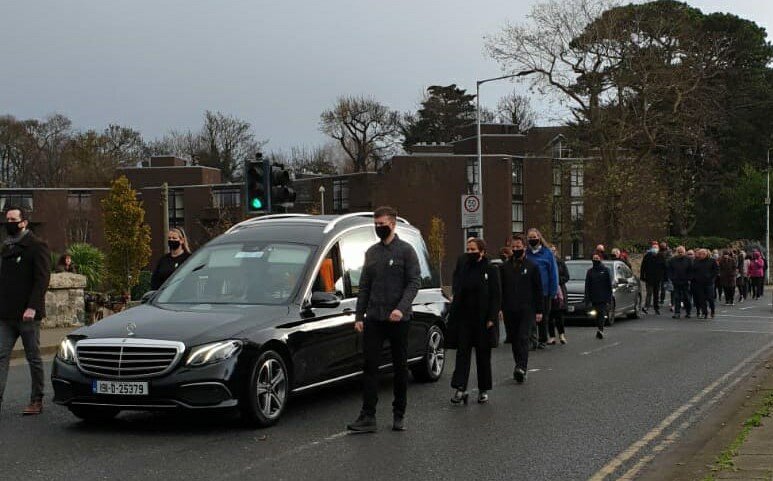
The hearse bearing the tri-colour draped coffin of Donal Ó Sé, flanked by a republican guard of honour, making the journey from Donal’s home to Milltown Church.

The hearse bearing the tri-colour draped coffin of Donal Ó Sé, flanked by a republican guard of honour, making the journey from Donal’s home to Milltown Church.

Donal’s earliest days on this earth were a time of simultaneous joy and tragedy for his family - joy in his arrival and tragedy in the passing of his mother who died in childbirth.

As was common with such tragedies at the time, family members stepped forward to help rear the infant Donal - in his case a childless aunt and uncle who had returned to Ireland after spending decades in the United States. While still a child tragedy again visited the young Donal’s life, with the death of his beloved Unlce Jim.

As the ten-year-old ‘man of the house’ Donal had to grow up fast, helping his adoptive mother Minnie with the many chores that came with running a small holding in 1940s Ireland. It was during these formative years that he developed both a strong work ethic and a deep hatred of injustice of every type.

The small holding where Donal Ó Sé grew up pictured today.

The small holding where Donal Ó Sé grew up pictured today.

His republican beliefs too developed as he moved through his teenage years - influenced by the rich republican history of his native county and by his adoptive parents who had supported the republican cause from America during the revolutionary period.

At some point in his late teens Donal joined the Irish Republican Army, a fact that became known to all when he was arrested along with 37 other republican volunteers during training maneuvers in Glencree, Co Wicklow in 1957.

Among the detained repubilcan’s were many who went on to become well-known national political figures including Seamus Costelloe, Sean Garland, Proinseas De Rossa and Peter Pringle.

Donal Ó Sé pictured in 2019 at the republican monument at the Cúl na Cathrach ambush site at Baile Mhic Íre

Donal Ó Sé pictured in 2019 at the republican monument at the Cúl na Cathrach ambush site at Baile Mhic Íre

Following a period of detention in Mountjoy Prison, Donal was moved to the internment camp in the Curragh, Co Kildare. The government of Eamon De Valera has introduced interment without trial earlier in 1957 in response to the IRA’s ill-fated ‘Operation Harvest’.

Unwilling to wait patiently for De Valera to release him, Donal took part in a mass prison break in December 1958. While many other prisoners were captured during the escape or shortly afterwards, Donal escaped the immediate area and remained at large until a general amnesty for all republican prisoners was introduced.

In the early 1960s Donal emigrated to England where he worked in the construction sector as a carpenter, until his republican activities attracted the attention of British police. A rapidly arranged trip back across the Irish Sea took Donal to Dublin where he gained employment with Dublin Corporation and met his future wife.

Donal Ó Sé remained a committed republican throughout the rest of his life as evidenced by his trade unionism, his love of Gaelic Games, traditional music and the Irish language. In the years leading up to his death Donal offered his support to Éirigí For A New Republic - the party he felt best represented the politics he believed in.

Eoin and Donal Ó Sé in happier times

Eoin and Donal Ó Sé in happier times

Donal Ó Sé was a quiet, unassuming man of few words. That quietness was not borne out of shyness or lack of confidence. Quite the opposite. It was a quietness borne of a deep understanding of the modern world and an absolute belief in Irish republicanism.

Donal had no need to shout from the hilltops about his exploits or his politics. He knew exactly who he was and what he believed in. Like thousands of other republican activists of his generation he did what he did because it was the right thing to do and he did so without any expectation of fame or fortune.

His republicanism manifested itself in the support that he offered to friend and stranger alike - in his instinctive rallying against injustice - in his support for oppressed people across the globe - in his political campaigning - in the unconditional love that he gave to his family.

Éirígí For A New Republic takes this opportunity to offer our deepest condolences to Donal’s wife Geraldine, his son Eoin and to their wider family during this most difficult of times. Ar dheis Dé go raibh a anam.


Saturday, October 3, 2020

"Phil Clarke - An Appreciation"

 Phil Clarke - An Appreciation

 Fermanagh Herald, Wednesday, August 23, 1995


   Forty years ago, a young Dubliner was selected as the sole anti-Unionist candidate for Fermanagh-South Tyrone. Like his colleague in Mid-Ulster, Tom Mitchell, Phil Clarke was tolerating Her Majesty's hospitality in Crumlin Road prison' having been convicted for his part in the raid on the armaments depot in Omagh. With staunch support from Fermanagh's best known clergyman of the time, Canon Tom Maguire of Newtownbutler, Clarke was elected to represent the constuency of Churchill's dreary steeples in the "Mother of Parliaments".

    Not for the first time, nor, as it transpired the last, the mandate of the Fermanagh-Tyrone electorate was ignored by a Tory government and Clarke, like Mitchell, was disqualified; eventually the constituency fell to a Unionist who held it for a long time.

    Four decades is a long time- long enough for memories to fade. Last week, Phil Clarke passed unexpectedly to his eternal reward without even a whimper of acknowledgement from his erstwhile constituents. Phil packed more into his sixty-one years than most. An international cyclist prior to his incarceration and a member of the only Irish cycling team to defeat England in a full international, he represented Ireland at a time when Ireland's international representation was adversely affected by Britain's refusal to acknowledge the N.A.C.A.'s right to nominate an International team for the 1948 and 1952 Olympic Games. His interest in cycling never waned; few Irishmen saw more stages of the Tour de France over the years; every year his continental holiday coincided with a major cycling event; and right up to his untimely death, he continued his Sunday morning stint on the bicycle as his gesture to fitness.

    A civil servant before his imprisonment, Clarke returned to the public sector on his release from Crumlin Road. Having secured a primary degree before being head-hunted by the Irish Management Institute where his innovative and imaginative approach to management development led to his appointment as Executive Director responsible for In-Company Development. While employed there he was awarded a Master's Degree by Trinity College for a thesis on management development and action-learning which was, then, a relatively new concept.

    Never one to suffer fools gladly, Clarke made no secret of his views when the I.M.I.’ s proposed policy indicated a change of direction which he felt was not in the best interests of the Irish economy. After a period of considerable confusion and some personal criticism, Phil left the I.M.I- with a not inconsiderable cash "gratuity" and set up a new consulting company with two of his former I.M.I colleagues. As a consultant he made a huge reputation for himself in the areas of industrial relations and wage payment systems. Regularly, articles by him appeared in management publications and contribution to the Journal of Industrial Relations on Gain-Sharing indicated a novel way of allowing workers to participate in the benefits from improved efficiency; it was a model which subsequently found favour in several of the country's leading companies and, indeed, in National Wage bargaining.

    Many, including his former colleague, Noel Mulcahy, now a Professor and Dean of Research at the University of Limerick, had often suggested to Phil that he should chronicle his involvement in political affairs, for he had a strong philosophical bent when discussing such matters. He always resisted. Then earlier this year, he produced a novel entitled "True Blue" (as befitted a died-in-the-wool Dubliner). He vehemently denied any autographical dimension to the book, but his trenchant criticism of politics and of politicians suggested to those who knew him well that part of it, at least, came from his own experiences and all of it came from his heart.

    Two weeks ago, he produced a first draft of a second novel to get the reactions of some of his closest friends. No doubt it too will be published even if it may need some re-drafting for its predecessor was rewritten at least three times before it was acceptable to a publisher. But Phil had enough friends to guarantee that his labour will not have been in vain.

    Seven years in Crumlin Road have their effects; Phil could survive well in his own company, but for those who made the effort to get to know him the reward was worthwhile; he was loyal to a fault; he had an outstanding intellect; despite his involvement with multinationals and big business, his political philosophy remained "left of centre"; he was a great communicator and an outstanding teacher — I know, for most of what I learned Phil Clarke taught me and I am eternally grateful.

    He will be missed by many; by Maeve, his wife his six daughters, Mary, Emer, Nuala, Philomena, Niamh and Ruth, by Adam, his son and fellow Dublin supporter, by his business partner and soulmate, Aileen, and by his brothers and sisters.

    Forty years ago Phil was deprived of electoral success; last week he lost an even bigger battle. Those of us who knew him, who considered ourselves his friends, also lost. Ar dheis Dhe go raibh se.


P. O'C July 1995


Friday, October 2, 2020

Tom Mitchell

Tom Mitchell


This past July saw the death of Tom Mitchell of Dublin, volunteer and MP for Mid-Tyrone at the age of 89. Mitchell was a significant figure in Irish history as the first Sinn Fein member to win an election in the north since 1918.

The following articles summarize his life and times, including his account of the Omagh Raid in which he was arrested.

A few notes may be added to what's below: Inside the Crum, Mitchell was elected O/c of the Republican Prisoners, and in Bowyer Bell's words, "proved capable of getting along with everyone and smoothing down the rough edges of faction."(1) Although he adhered strictly to Army policy, there was no crippling infighting such as split the movement in the Curragh at the same time.  He stood down in favor of Sean Garland in 1960. Upon his release in 1961, he served on the Army Council and voted to end Operation Harvest the next year.

After his release he returned to Dublin and became a planner on the Dublin Corporation. He retained a close connection to his Tyrone constituents, and appeared in almost any republican rally, commemoration, or funeral in the area. More than one former comrade notes he was wary of far left ideology, but firmly believed in popular politics and the political process.(2) He was active in the NICRA, was a member of Official Sinn Fein, and supported the WP-affiliated Republican Clubs through the 1980's.  According to his Irish Time obituary, he "often played a significant role as peacemaker behind the scenes."(3) Thomas MacGiolla described him as "a quiet man who hated the limelight, and had no desire for publicity."(4)


(Click to view larger versions)


(From the United Irishman)


Election Photo, 1967


At the unveiling of the republican monument in Carrickmore, Tyrone, 1971.
The monument was a decades long project initiated by the Old IRA veterans.


1971


In Support of a "fish-in" protest. 


Saturday, April 23, 2016

Men of the North Part 3: Operation Harvest


Men of the North Part 3: Operation Harvest


"What gifts hath fate for all his chivalry?
 Even such as hearts heroic oftenest win
 Honor, a friend, anguish, untimely death."
    -Homer, "The Iliad"


THE HANDBOOK


After the Savoy attack, an op-ed writer theorized:

    "In the North...there are signs of a breeze that may trouble the waters. There is no reason to believe that the IRA is in a position to carry out any grand strategy. The odds, in the Republic and the Six Counties alike, are balanced too heavily against it. No sane Irishman wants any more of that hopeless nonsense. At the same time," he continued, "the fanaticism of such members as it may have has not diminished; and a man with only one idea in his head is always dangerous..."

   By evidence and logic, the IRA certainly did seem to have disappeared. But rarely in Irish history have events progressed according to those two. In reality the IRA did have a grand strategy, thanks to a former Irish Army officer, Sean Cronin, and his idea was called "Operation Harvest." By his plan, the IRA would strike across the border from the south using mobile, well-armed columns of 12-15 men. Their attacks on the British Army and government infrastructure would make the country ungovernable and inspire the nationalists to rise up. They would be assisted by smaller Active Service Units of northerners and southerners fighting full time, and the local units that existed around the north.

   The few dozen men under Jim Rowntree that comprised the Newry unit were of the latter category. They were "local men," whose role was to "work during the day, go about their normal routine, and then strike at night. Their job is to stay constantly on the offensive, keep the enemy off balance and keep him guessing." Although far removed from the (skin deep) romance of flying columns dashing across the hills, they did the crucial grunt work of the army: gathering intelligence, sheltering men and hiding arms, providing guides and for the ASUs and columns, carrying out support operations and sabotage, and making sure the army maintained a presence overall. They had the camraderie that comes from small numbers, common sacrifices, and shared secrets.
 
Jim Rowntree 1921-2002
(source:Evening Herald)

     In 1956 Cronin wrote a "Handbook for volunteers of the IRA" to prepare them for the job they were about to undertake. Cronin was a journalist by trade, and typical of his writing it is precise, well-detailed, and owing to his army background, a cut above the average guerrilla cookbook.

    "The Guerilla must always remember that his main job is the destruction and breakdown of enemy communications, administration, and supplies," Cronin writes. This would primarily be done by local units, and their tools to this end would be explosives. The handbook describes the appearances, uses, and storing methods for gelignite, 808, TNT, ammonal, wet gun cotton, plastic, and 822, in addition to several paragraphs on bangalore torpedos (useful against "enemy tanks and barbed wire") and the three primary detonators.

        Gelignite, ("brown, used for cutting. Initiate with primer. Can be initiated with bullet. Keep in cool place."), was the only one the IRA made a habit of using. It was the most readily available, having a legitimate use in quarries and mines, and could be obtained from them legally under the disguise of "stuff exports." It was the most stable, and can be knocked around without setting off the charge. And it was the most familiar, having been used for several generations going back to the Fenians. "Wee Joe," Seamus Trainor, and their generation were versed in its use. Many Old IRA men who bedecked the Easter Parades had used it in their day, and an early form was used by their predecessors in the IRB.

    The primers and fuses which make the stuff go off were another story. One had the option of electric fuse or copper wire, and they were more volatile than the explosive itself, particularly when exposed to moisture. It was not unusual they failed to work but many volunteers, happy to get away from the scene after working in the dark with one eye watching for police, did not usually risk their lives and freedom to go back and fix it.


THE CAMPAIGN


On December 12, the campaign opened along the border with a salvo of raids and attacks; watching and listening for the explosions across the border one volunteer thought it looked "like the western front."

    The original plans for South Down were: "Destroy Territorial Army station at Newry and burn down courthouse. Destroy Banbridge Territorial army Station. Seize short-wave Radio transmitter in Newry shipping office. Hit Warrenpoint R.U.C. Barracks. Raid Bishopscourt Radar Station."A variety of factors worked against all these being carried out. The party assigned to raid Bishopscourt set out but was forced to turn back and in the end only a hut in which B-Specials drilled in Newry was attacked and mostly burned down. The columns that marked activity in the western counties were absent from Co. Down, and the area was quiet over Christmas.

    A column of volunteers from the southern side of the border moved into the area around New Years.  They set up a staging point for operations at a lonesome farmhouse a full mile off road in Clontifleece- a "wild and sparsely populated" area at the base of the Mourne mountains. They were joined by three locals, Christopher and Bernard Loy, and Thomas Kearns. These latter three, along with Seamus Hand, Peter Duffy, and Pat Shaw of Dundalk, and Pat Considine of Dublin from the column torched a B-Special barracks the night of January 2nd-3rd. Unknown to them as they hiked cross-country back to the farm, the authorities were on to them and a landrover of six policemen armed with sten guns and revolvers was approaching from the other side. As they jostled up the long rocky lane they passed the farmer walking away the house. They stopped the car and split up, approaching from different directions.

    The column had apparently sensed the presence of the police, and was crouching along the wall of a pen while one man leaned over to dump their materials in it. A policeman, armed with a sten, came up behind. The others were soon on the scene and the column, in no position to shoot it out or escape, was captured. They calmly stood up and assembled along the farmhouse wall. The police, outnumbered and in dark, unfamiliar surroundings pressed the volunteers with shouting, threats, and prodding with their stens to disclose where their explosives were. None gave an answer and no explosives were found in the area, although in various places around the pen and in the haversacks each was carrying were tell-tale detonators, small arms, knives, copies of Cronin's manual, and ordnance survey maps. A lorry arrived on the scene shortly and took them away.

    This means 12 years for us, one remarked grimly. Although that imminent sentence hung over them, they played it cool at their trial, chuckling at inside jokes as evidence was brought forth and waving to some women in the gallery. It wasn't as bad as predicted: they got 8 years each.

      The following day over 500 police and members of the British Army carried out one of the largest sweeps seen in South Down for some years. They combed the Mourne mountains and arrested two hapless volunteers who were caught in daylight on the barren landscape with nowhere to hide, and uncovered a dump of the usual items near Rostrevor. House to house searches followed.

     On the 9th a false alarm provided some comic relief when a parachute with a "small object" descended out of a clear blue sky and came down in the middle of the road. Those watching assumed that this was an innovative new weapon of the IRA, and took cover. Before the bomb squad got there a taxi man ventured to pick it up. It did not explode: it was a meteorological instrument that had run its course. There were similar scares throughout the spring as ordinance and ammunition were found around disused installations that housed the US Army during WW2.

     On February 22nd, about 40 Territorial Army members were drilling in one of their huts on Downshire road. They left for the much-awaited canteen. Half an hour later an explosion from under the hut gutted it, leaving only the frame and blowing out the roof, windows, and sections of the floor. A comedy of coincidences prevented casualties. Two men on their way to relieve the sentries, and a caretaker who just happened to be outside were all shielded from injury by a landrover, and the sentries were protected by the sandbags around their post. The men in the canteen were thrown to the floor like ninepins but, aside from scrapes, bruises, and a bump on the head for one who was struck by a wireless transmitter, all were fine. This attack, like the previous two barracks bombings in Down, was timed specifically for when they were empty so as to avoid casualties: the objective was to deprive the police and TA of their safe places, rather than to rack up a bodycount. This attack prompted more searches through the mountains.

    Through late February and mid March targets in South Down focused on telephone transformers, wires, and kiosks to isolate communications, and some bridges were damaged in attacks to isolate troop movements. The Fianna were tasked with the former job of cutting wires, done by hurling over a rope with a stone attached and pulling them to the ground. Flickering lights and momentary power loss to the sound of not-so-distant explosions were common. "Once (indeed more than once) it was the local (transformer) on the site of the present Southern Regional College," writes one local. "For minutes at a time (or so it seemed) the sky was filled with multi-coloured flashes, then all went dark."

     The British for their part took to felling bridges to isolate IRA movements and it was not always clear to observers who was responsible for what. To control traffic they made roads some impassable by alternately blowing very large craters in them, or placing iron spikes, or concrete blocks in the way (or a mix of all 3). By 1958 only a handful of the 180-odd roads across the border in the north were open, and travelers on these ran a gauntlet of searches and roadblocks by the RUC, and B-Specials, and less commonly the British Army.

     There was an old abandoned house on Chapel Hill the police frequently raided, believing it to be a hideout. Their searches brought nothing by way of volunteers, but on  March 1st they found a bomb waiting for them with 28 pounds of gelignite primed to go off. The police deferred to an army bomb disposal expert, who claimed it was the most complicated device he had encountered.

   On March 6th, in a fairly straightforward operation, an explosion leveled an army recruiting office which had just opened in November. The issue of army recruitment was one that would surface later with more drama than a simple explosion.

    Just after this, two volunteers "borrowed" a taxi cab for an operation, long enough beforehand that the owner reported it stolen. Around 8:15 in the evening, residents heard them racing up Frances street, accompanied by the sound of the Electricity Board's windows shattering as a bomb was hurled through. The volunteers ditched the taxi a hundred yards way at Merchants Quay, unharmed and ready to resume its legal use. But there was no explosion. The street was closed and the police and fire brigade watched as military disposal experts were called in. They found a 2 foot long iron water pipe with 75 sticks of gelignite stuffed inside, along with a 12 foot fuse that had burned out only an inch and a half away from detonation. Speculators pointed out a garage with underground petrol tanks was next door, although whether they intended to cause an explosion with that, or if the gelignite was capable of doing so, is debatable. The street was then reopened.

    On March 11th William and Sheila McCormick resumed life at their respective places of work after a five-day honeymoon. Around midday, word went around Sheila's workplace that police raids were going on- an unusual occurrence as that usually came around in the wee hours of the morning. On her lunch break she asked a neighbor what the sceal was only to find that William had been taken away. The police arrested a total of seven volunteers in precise daytime raids: Oliver Rowntree, Vincent and William McCormick, Bernard Larkin, John Duffy, and Lennie and Edward Campbell. Sheila appealed to Joe Connellan for help, who called for William's release without result.

      The Easter commemoration that year was one of the largest in recent memory. The streets were flooded by a sea of over 5,000 people, who left just enough room for the Old IRA veterans' color party to lead the procession through. Their route passed through a police cordon and there was no chance of the tricolor passing it; the flag was kept hidden until they had gone through, whereupon it was pulled out and triumphantly borne aloft to St. Mary's Cemetery by Bob Savage. Dr Padraig O Cuinn read the proclamation and led a decade of the rosary, after which four buglers sounded the last post.

    The police arrived at Bob's home in the early hours next morning and arrested him for the tricolor stunt. A few days later in court, the judge ordered him to pay 10 pounds. Bob was released but promptly ignored the fine out of principle; he ignored the reminders and finally in September he was arrested and given a month in jail for non-payment.

   Bob was not the only Tan War veteran to be arrested. After the attack on February 22, among the homes searched was that of 66 year old Christie Loy. Christie was one of the Sinn Fein stalwarts of Newry, and sold record amount of issues of "The United Irishman." Rummaging through his bedroom they found, in a cabinet, copies of "The United Irishman," "Ghlor Uladh," and "The Writings of Philip Clarke" (a 30-page pamphlet promoting one of the IRA candidates who won his seat during the 1955 elections)- all banned. Loy arrived home late that night from his job at the Gas Works and was promptly taken away. The prosecution tacked membership of Sinn Fein on to his list of offenses. His hearings lasted a matter of minutes, during which he took full responsibility for the documents and gave a defiant statement:

" I am proud to claim I have been a member of the republican movement for a long number of years. And if I may be allowed to say so, I am proud to be the first member of the civil arm of the republican movement to be charged with this offence, if it is an offence...I have been a member of the Republican movement since I was a youth of 11 years, and I have continued my association with the movement from that time to the present time and I have no regrets in that connection.

"I hereby state and proclaim the fact that I am a soldier of the Irish Republican Army, and I am proud of my connection with that organization. That about sums up all I have to say. (Then, in Gaelic:)Long live the Republic.

"Thank you sassenachs."

   The "sassenachs" sentenced him to nine months in the Crum. A crowd showed up to cheer him on and as he was led away to the police van a lady broke through to give him a cigarette. He joined the growing list of incarcerated Loy's.

    Such arrests were doubly significant as the men of Bob Savage and Christie Loy's generation were an inspiration for the movement. The Tan War Flying Columns were the basis for Sean Cronin's campaign. The young volunteers grew up in the shadow of their exploits and looked back a little longingly for the days when a republican soldier could fight such a war. That some of them remained involved over thirty years later gave both impulse and a sense of legitimacy in the movement's undertakings.


NEWRY'S BORSTAL BOY


After Bob Savage raised the tricolor, someone had the presence of mind to take a picture showing the color party and their flags marching towards the camera head on in all their determined glory. Under the tricolor, a few steps behind Bob, one can make out a young teenager, much smaller than those around him but well dressed and with accomplished air of an older volunteer. This choir-boy face was actually the brains behind some of the explosions that rocked Newry.
 

The rebel of his family, Dessie Mathers joined the Fianna in 1955 at the age of 12 and loved the republican lifestyle. The Newry Fianna was the first in the north to show itself publicly since the organization disintegrated in the 40's, marching in uniform at Easter in 1952. They had around half a dozen boys, including Oliver Craven, whose fate was then quite unknown as they marched in their green uniforms and slouch hats looking very much like the first Fianna boys of 1909. Selection was rigorous, and took into account their moral background rather than purely physical abilities. Theywere expected to parade twice a week, drill, and attend classes on Irish language, history, and politics. There was scout-style training consisting of camping out in the country over a weekend. Weapons training was forbidden, but smuggling them, and the construction and transportation of bombs was not- it was a time honored Fianna service to the active volunteers dating back to the days of the Howth Gun Running. In this field Dessie discovered a talent.

     However, his mother was unaware that there was more to the Fianna life than parades and dress uniforms. This had complications for the boy, who was barely out of primary school. One time he missed his brother's wedding so he could attend a training camp in Omeath, for which his Ma "battered him." Later, when working with bombs, he would arrive home reeking of unknown odors (gelignite), for which he was further battered. Facing his mother was only slightly less frightening than cutting live telephone wires; or the bomb he set which failed to explode, and Dessie undertook the job which earned British sappers respect from their IRA opponents, that of disconnecting a live and volatile explosive.


     Anecdotes of his hijinks abound. One day while his brother was playing in the street there was a "heavy" explosion, the sort whose concussion left both houses and people trembling far away from the epicenter. "Its the end of the world," an old matron shrieked. Reality was more mundane- it was his younger brother at work. Another night a girl was in the process of "getting it on" with a boy whom she had been eying for some time without success. They went into the backyard and just as she was about to kiss him the mood was interrupted by an explosion. The lights went out, and in the darkness she watched a small figure hop the fence behind her and ran away. It was some time later when she met her cousin's boyfriend and instantly recognized him as the shadow than ran through the yard that night. Dessie was known to her as "Blackout."

   In the midst of this he was still attending school, and played on the local soccer team. He was a messer by nature and was not about to let a little thing like age get in the way of something he liked doing, although he earned the unsurprising sobriquet "The Child" from the other volunteers. He would leave his mark on the town  before the campaign was over.


 MORAL FORCE AND OTHER THINGS


     On the night of May 12, two lorries of "masked men with blackened faces" approached the Victoria locks, which guards the opening of the Newry canal, built as an artificial link for shipping between the industrial city and the sea. Three approached the small wooden house on site where the lockmaster lived, relieved him of the keys, and told him and the family to get away quickly. They then accessed the locks on which two gelignite bombs were planted. They watched them detonate from the shore before driving across the border. The operation was carried out swiftly, for the gatekeeper and his family had only gone a hundred yards up the road when they felt the explosion.

      Locals woke up to see water gushing through the mutilated lock into the river. Newry port was closed, shipping was blocked, and incoming goods rerouted to Belfast. Repairs initially cost £50,000, but by the time it was finished the following January the cost grew to £350,000. A small vessel was trapped and it cost further expense to extract that. The closing of the port left over a hundred dock workers idle- in a town in which one in six people was unemployed. (Nationalists for years accused the British of depriving Newry of jobs.)

     No one was perhaps more surprised with this than the local IRA men. Reports of sabotage by masked men with guns were taken to refer to them without further inquiry. In this case it was not so: Jim Rowntree had not cleared any such operation, and the army foresaw with horror the political fallout this could produce. They called the Urban Council Chairman, "on behalf of the Adjutant General (Charlie Murphy)" of the IRA and denied responsibility. They then distributed a statement around Newry declaring they had no hand in the explosion and decrying it as the work of "pro-British saboteurs."

   "The object of the Storemont saboteurs was two-fold:

    "First, to strike what was hoped would be a crippling blow to the economy of the Newry area- a nationalist stronghold- by stopping all work at the port.

    "Second, by putting blame on the resistance and so give it a bad name among the Nationalist people of Newry.

    "Storemont has been unsuccessful in the second of these aims and only partially successful in the first."

 And in conclusion they reiterated:
      "It is not part of (our) campaign to engage in operations designed to damage the material interests and welfare of any section of the Irish people."  The statement, which was reproduced in the next issue of the United Irishman, went on to try and find gaps in the evidence as reported in the papers. They even posted photos of government leaders repeating the accusation beneath as if they set the fuses themselves.

      The explosion was actually the work of Saor Uladh, backed up by the Dublin-based Christle Group. The latter had stolen the gelignite explosives from stores in the south, and thanks to a masterful explosives expert they destroyed the target rather than simply causing some damage, or worse, a burned out fuse as was the result of so many operations. In J. Bowyer Bell's words, it was "immense damage at a minimal cost." And their volunteers were not a little put out at the IRA's denial. They considered it to be akin to "felon-setting" and "aiding the (authorities') process of elimination" against the interests of a group fighting against a common enemy, and whose help the IRA availed themselves of when it suited the leadership. In any event, the Victoria Locks bombing is often to this day mistakenly blamed on the IRA.

     Two years prior when Joe Christle was the rising star in Sinn Fein, he delivered the Easter oration in St. Mary's cemetery. With Dan Sheridan next to him, he applauded the Old IRA men and proclaimed with Pearsaic oratorical flair:


 "A new generation has come of age since these men fought- a generation which has inherited the ideals for which they died...Here today, in this spot and during this peaceful feast of Easter we promise: never to yield; never to cease our efforts against the enemy; never to cooperate with the government; but to train ourselves in the use of arms, and having made ourselves proficient with the weapons of war we shall take up the fight where Newry's patriots fell."
On the subject of the army's activities as opposed to those of the Nationalist Party, he added:
   "Is it for using moral force that Joe Campbell and our fellow republicans are this day confined in the penal cells of English prisons? The answer is 'no' and the reason is obvious. England has no cause to intern anyone advocating moral force, because such a weapon can never harm her. . ."

   Christle had a more drastic maneuver in mind than the bombing: a takeover of the city, which he hoped would set off a chain of events to involve the British Army and Free State Army in open conflict. However, Liam Kelly, ultimately in charge of Saor Uladh, and his aides would have none of it. (The idea of the Free State invading Newry came back a decade later in the form of a rumor that circulated during the "events of '69" )


 (To be continued....)