Taken from Chapter 4 of John McGuffin's masterful book "Internment"
"The 1956-1962 border campaign was planned well in advance. Raids at Felstead (Essex OTC school) in July 1953, Gough barracks, Armagh, in June 1954, and Arborfield on 11 August 1954, had gained guns and kudos, as well as life sentences for Donal Murphy, James Murphy and Joe Doyle,[33] and eight years for Cathal Goulding, Sean MacStiophan and Manus Canning. By December 1955 the IRA felt it could act. In many ways they were more sophisticated than before, but the old naïveté persisted. In a directive from Oglaigh na h-Eireann to all O/Cs, dated 12 December, GHQ stated;
In view of recent pronouncements by the leader of the Twenty-six County Government and his reminder to the press of the fact that certain Acts, passed by the Leinster House regime in 1939, are still in force, it is not reasonable [sic] to assume that coercive measures against the army are under consideration by the Twenty-six County authorities.[34]
The campaign got under way on 11 December 1956 with a series of explosions. Eleven days later internment was introduced in the North and 30 men were lifted; the figures rose to 256 (about 400 were detained at first). After signings-out, 167 remained in for the duration. On 1 January 1957, in the abortive Brookeborough barracks raid, Sean South and Fergal O'Hanlon were killed, only to become immortalized in the Republican songbook. All 12 survivors of the raid who got back over the border got six months under the Offences Against the State Act for refusing to answer questions, but massive turnouts at the funerals of South and O'Hanlon convinced many Republicans in the South that the Taoiseach, Costello, would not move against them. Nonetheless, on 8 and 12 January swoops netted virtually the entire IRA council and GHQ staff, including MacCurtain, Magan, Grogan and Russell, who all ended up in the Bridewell and later in Mountjoy with three six month sentences. The number of prisoners rose to 53, but MacBride and his party, Clan na Poblachta, forced Costello to call an election. Fianna Fail won with 78 seats. Republicans were jubilant. De Valera and Fianna Fail had condemned the arrest of the Republican prisoners, and surely they would release them as they had done in 1932.
Sinn Fein polled 65,640 votes and had O'Bradaigh, J.J. Rice, J.J. McGirl (in Mountjoy at the time) and Fergal O'Hanlon's brother elected. Now they could even claim some sort of mandate from the people.
The elation was to be short lived. Some prisoners were released. But on 4 July 1957 an RUC man, Cecil Gregg, was killed at Forkhill. Colonel W.W.B. Topping the North's Minister of Home Affairs, demanded internment in the Twenty-six Counties. The Dail had adjourned for its summer recess that day, but within the next two days 63 Republicans were arrested. Most had made no attempt to go underground, believing that quiescence in the Twenty-six Counties would guarantee immunity. They had no concept of the economic and diplomatic pressures which could be put upon the Southern Government and, despite their abhorrence for politicians and party politics, they had failed to realise how easily TD's or MP's can shelve their principles.
On 8 July the Government of the South announced that Part 2 of the Offences Against the State Act was in operation. Internment was on again. Those Fianna Fail TD's (especially in North Tipperary) who had publicly supported resolutions calling on Costello to release all Republican prisoners had to keep quiet or resign. There were no resignations. Moreover, 36 Republicans still in Mountjoy were trapped. On their release, they would go straight to the Curragh camp. On 20 July, 24 tried to escape with a large scaling ladder, but were spotted. All were soon in the Curragh camp.
Conditions this time were better, but certainly not as pleasant as T.P. Coogan paints them in The IRA. The Irish Red Cross, headed by Mrs. Tom Barry, inspected the camp and found it 'excellent'. She, however, did not have to live there. Numbers were fewer – four huts with 40 men in each hut,[35] but the huts were still damp and dirty and the timbers were rotting. The camp authorities claimed that red tape was responsible for delays in obtaining new planks, and it was a year before the rotting timbers were replaced. The camp was surrounded by five sets of barbed-wire fencing and there was a trench, six feet deep and eight feet wide, which was booby-trapped with flares. Watch towers were manned by armed guards who also patrolled the perimeter and were equipped with ammonia grenades. Despite these precautions there were escapes. Three prisoners, Conlon, O'Toole, Kelly, climbed through the showers' window, an obvious weak spot in the defence, and made off but were recaptured a few days later. This provoked intense speculation in the camp. Official IRA policy was 'no escapes, it's too risky', but many internees were unwilling to accept the rule. On 27 September 1958, Rory O'Bradaigh and Dave O'Connell (then 18 and now a leading Provisional), escaped through the wire during a football match and, after hiding under a camouflage grass blanket, made their escape. This was an 'official' escape, made with the blessing of the O/C MacCurtain. But to the men in the Charlie Murphy group, brooding in their hut, which was known as 'Little Rock', it was not ambitious enough. Accordingly, after hearing from Sean MacBride that the International Court at Strasbourg would be unlikely to find against the Government, Murphy decided to go ahead with a mass break attempt. The military guards were accustomed to frequent alarm drills often caused by sheep springing the trip wires. They were, therefore, somewhat lethargic. On the face of it, the attempt was madness, but, on 2 December, 26 men armed with wire cutters rushed the wire in broad daylight. The guards were so astonished that the men were through the first fence before warning shots were fired. The men ignored them and ran on past the guards. Brian Boylan was shot and wounded, but the rest cleared the second and third fences. At the ditch ammonia grenades were hurled at them, flares went off and prisoners reeled about in a haze of gas while bullets flew. The guards did, however, fire high – the only man who did not was disarmed by a prison officer. Despite the wire and gas 16 men got through and only two were recaptured. A week-long police and army hunt was in vain because the local people hid most of the escapees.
Surprisingly, there were no reprisals in the camp and life continued as boring as ever for most of the prisoners, the oldest of whom, Padraig O'Ceallaigh of Mayo, was 68; the youngest, 17-year-old Michael Kelly of Galway.
The huts were open at 7.00 a.m., and recreation included football and darts as well as handicrafts; the usual plethora of crosses and handkerchiefs was produced. Frank McGlade, who had experienced internment in Derry, Crumlin, and on the Al Rawdah, was in the Curragh during 1958-1959 (he had been on the run since 1956) and described it as his 'favourite'. He liked the open countryside, but found it ironic that the tricolour flew and the huts were named after men like Pearse, McDonagh and Brugha.
This time the campaign to release the internees was more active. It was costing the Prisoners Dependants Fund £400 a month to keep up the payments, inadequate though they were, and money was scarce. The imaginative suggestion of internee Frank Driver that a wife of an internee with ten children should take them to the palace of the late Most Reverend Dr. John C. McQuaid, Archbishop of Dublin, and deposit them there for safekeeping until her husband was released, was not put into operation. Nor was his scheme for a band of women relatives to march on the camp armed with wire cutters and cut their way in. More practical steps were taken. Sean MacBride took up the case of Gerry Lawless. Lawless and eight others had been interned in July 1957 but were given a separate hut to themselves because they were ostracized by the rest of the camp. Eight were released upon signing an undertaking, but Lawless, who was not in the IRA, having sided with Joe Christle in the split, refused to do so. After the appeal to the High Court failed, MacBride took the case to the Human Rights Commission at Strasbourg, where it was entered in November 1957 and ruled admissible on 30 August 1958.[36] On advice of his lawyers, Lawless signed out on 10 December 1958. It was not until 1 July 1961 that the verdict was eventually given, long after the last internee was released. It went against Lawless (as Unionists such as Brian McRoberts were to gleefully point out whenever internment was challenged) but mainly on technicalities. It did establish that the 'undertaking' given by internees who sign out has no legal status since it was not included in the Offences Against the State Act. Even more importantly, the court ruled that it was for them to judge whether a state of emergency existed in the country in question and that in future they need not merely accept the assurances of whatever government chose to opt out of the provisions against detention without charge or trial – as Greece was to discover in 1970.
The IRA border campaign of 1956-1962 was an almost unmitigated disaster. The IRA could claim that about 200 militants had taken on 5,000 TA men, 3,000 RUC men, 12,000 B men, 1,500 specially trained commandos plus a large number of security guards – close on 30,000 men. There had been, in the five-year campaign, 300 major incidents. And several hundred minor ones. Six members of the RUC had been killed, 19 wounded. Eleven B specials and two soldiers had been wounded also. Several million pounds of damage had been caused – the overtime bill for the police alone was £10m. But in the last analysis the campaign was an abysmal failure. Two IRA men had been killed in action by the police and five had accidentally blown themselves up. The people had not rallied, as anticipated, behind the IRA. The Six Counties had not been 'won back'. The Unionist Government had, indeed, been strengthened. "If the IRA had not existed, they would have been invented," as many a Unionist politician said to his friends. And so the campaign petered out. By 15 March 1959 the last internee in the South had been released. The North was not to follow suit until April 1961. A forthcoming visit of the Irish President, Sean T. O'Kelly, to the USA probably had something to do with the Southern Government's decision, but by then it was clear that the campaign was sputtering out. Moreover, there were always the military courts to sentence recalcitrants. Accordingly the Curragh was closed.
http://www.irishresistancebooks.com/
internment/intern4.htm
Saturday, November 30, 2013

"Omagh and After" - 1954
The following is a piece from The Spectator (26 Nov, 1954) after the botched raid on Omagh Barracks.
OMAGH AND AFTER
By JACK WHITE
Dublin.
DRIVE ENGLAND OUT :
"It was an army of soldiers that England first sent over to conquer our Nation. It is with an army of soldiers that England today maintains the conquest of our Nation. What established the conquest and what maintains the conquest—FORCE--is the one effective weapon that we can use to undo it."
This succinct statement of policy appears in a small news- sheet published in Dublin and entitled The United Irishman. Below is a list of names--including two in Scotland and one in England—of ' contact addresses for people who wish to join the -Republican movement.
Lest they should be in doubt about what they are doing, the advertisement says : "An active Civil Organisation backed by a strong military arm can smash England, but not without your help.' And on the front page is a glowing account of the raid by the Trish Republican Army on the Omagh barracks.
The name of the IRA recalls to British minds, no doubt, the days of 1939 anthe days of 1939 and bombs in pillar-boxes. To the Irishman it rings with half a' dozen different notes. For it was an IRA that fought the Black and Tans, and its ex-members today draw State pensions and parade on Easter Sunday, decked with medals, behind the Aryl), hand,
The IRA split on the Treaty, and when the civil war began Mr. de .Valera threw in. his lot With the anti-Treaty faction and became their nominal head.
But, in 1926, when he decided to form his political party, Fianna Fail, the IRA split away from him, too: and he, who was once its leader, became one of its bitterest enemies when his Government was obliged to execute IRA members., From that time onward it was an underground movement, proscribed by law, rent by its own differences of leadership and policy. With no leaders well known to the public and making little impact on everyday life.
The strength of the IRA has always been a matter for conjecture, and remains so today. It must be so, indeed, because it is impossible for even the well-informed outsider to draw a line between, the " activists" ' and the mere fellow-travellers and sYmpathisers. During the war the number interned was about 2,000 (nearly 1.000 of them in Eire), and the total strength may have been 7,000 or 8,000. But the war brought a major split on principle. The rightists and the opportunists —those whose only principle was to support anybody who was fighting England —wanted to aid Germany. and some contacts were in fact established. But the leftist-liberal element, which has always been strong since the days of the Citizen Army, could not stomach the idea of an alliance with the Nazis. In the prison camp this split on principle was embittered by the clash of personalities. and when war ended and the internees were released the IRA was only a remnant of its former strength. The last few years have seen a rebuilding of the organisation combined (apparently) with changes in leadership and policy.
The pre-war IRA was purely a military movement which called itself a 'government.' Today it is the military arm of a political movement whose speakers appear in public and which publishes The United Irishman. The " activists ' number perhaps 800 to 1,000. They still have substantial dumps of arms, and they are sustained by funds coming largely from America. As a matter of policy, the organisation seems to have abandoned the wiping out of old scores within the Twenty-Six Counties: there is no more talk of the ' execution lists' that were notorious during the war. The new policy is concentrated on one objective, expressed by The United Irishman: . . . ' after thirty Years or futility . . . getting down to the 'vital, fundamental Issue—to get the invaders out, completely and as quickly as Possible.'
"The invaders": those words are the keynote. It is an article of faith that England is the only architect of Partition. The United Irishman denounces those who misrepresent' the purpose of the IRA as an attack on Northern Protestantism as such and no doubt it is sincere, as it is no part of the IRA
tradition to be the spearhead of "Rome Rule.' But one can imagine that the distinction seems a fine one to the 750,000 or so people in the North who vote Unionist. In fact, this distinction, or lack of one, seems to lie at the root of the conflict between IRA policy and Government policy. In the Dail debate that followed the Omagh raid, Mr. John A. Costello, the Prima Minister, made a reasoned case against the use of force, and he was supported by Mr. de Valera as leader of the Opposition. Both of them accepted explicitly the fact that' the ending of Partition depends on winning over the Northern Unionists, and that getting the invaders out.' even if it were possible, would
be no solution. Let us have a united nation,' said Mr. Costello, but let it be a union of free men, and not a united nation in which one-fifth of the people have been cowed by • force or fear and feel themselves enslaved.'
How is it that, against all this consensus of political wisdom, the lRA can still gain recruits for its ' physical force ' policy? The answer 'is that those political leaders themselves, who . have now attained to wisdom with the years, have put the sticks under the pot. The right of a fervent minority to take it upon itself to represent the nation is sealed by the niemory of 1916 (when there were some 300,0(X) Irishmen in the British forces, as compared with a thousand in the Rising) and 1922. The "lesson that you can get nothing out of England except by force ' is rammed home by a teaching of history which represents a gallant Ireland as forcing the mighty Empire to its knees. In fact, for all the courage and resourcefulness of the men who carried on the war, the victory was won in 1921 by public opinion, in the world at large and in Britain itself. And it is that force of world opinion which would be firmly, decisively and almost unanimously against any use of force to reunite Ireland today. To Americans-- --even to Irish Americans. -the alliance with Britain against Communism is too important- to be jeopardised by quarrels like this.
The elder statesmen lit the fire, and now they find themselves ignored or scorned when they try to damp it down. Indeed, it is not hard to see why their hard-won wisdom is spurned by those ardent young men whose anger has been aroused by the injury of Partition. Not only the extremist but the moderate must feel that thirty years have failed to produce a positive policy on Partition, and that moderation, in the official mouth, is only an excuse for doing nothing. It is possible, I feel, to produce a policy which, if it will not appease the extremists, will relieve the moderates of their feeling of frustration. First of all, there is one point on which the Northern Ireland case is vulnerable, and can be shown to be vulnerable. The two counties of Fermanagh and Tyrone have consistent nationalist majorities, and there is no argument for dividing the Six Counties from the Twenty-Six which will not go equally for dividing these two from, the Six. Here is the point on which to concentrate propaganda. The alleged misdemeanours of the Northern Ireland Government. which Republican spokesmen have spent so much time in denouncing, are totally irrelevant, as long as it continues to get elected.
Secondly, there is no evidence (or at any rate none known to the public) that the Government of the Republic has ever given a day's thought to the practical problems—fiscal, financial, economic—which would be raised instantly by the abolition of the Border. Why should it not appoint at once a non-political Working Party, to ask the necessary questions and try to work out the answers ? A start could be made with an examination of the practicability of a customs union between North and South. Here there would be the precedent of Benelux. and the blessing of OEEC; and no doubt the scheme could count on United States support. It would be at least a start towards a plan for wiping out a Border which cannot, after thirty years, be demolished simply by proving it absurd. if the result was merely to force an ackhowledgement of their true position on some of the Southern businessmen who are making money out of non-competitive, tariff-protected industries, the Working Party would have paid its keep.
Friday, November 29, 2013


The Welsh Ivy
Some readers might recall a post about the Welsh republicans in the 1950's. On that note, here is an explanation of the Welsh equivalent of the Easter Lilly . Do remember to wear an ivy - or stick up one of the following designs (see photo and links below)- as a gesture of support.

DECEMBER 11- WEAR YOUR IVY
Irishmen wear an Easter Lilly to honor their dead, specifically on Easter Sunday; the English, a poppy on November 11; the Scottish, a thistle; but were you ever told of the Welsh day of mourning and its symbol?
On December 11, 1282 , Llywelyn ap Gruffydd, the last independent Prince of Wales (thereafter known as "Llewlyn the Last") met the forces of King Edward I at the Battle of Orewin Bridge. It was the culmination of decades of struggle between Norman expansionism and the Welsh princes and leaders, many of whom had made peace (or compromised) before but were forced into rebellion by Norman taxes, laws, and aggression against those who remained independent.
During the battle, Llywelyn was separated from his army under questionable circumstances and ambushed near the town of Cilmeri, along with 18 of his guards, retainers and chaplains who were with him. As he lay dying he revealed his identity and was executed on the spot. His head was afterwards cut off and paraded through London where they crowned it in ivy in mockery.
Llywelyn's 18 companions were killed as well, along with most of his army. His brother Daffydd fought on for a short period but was captured and became the first recorded person to be hung, drawn, and quartered.
Wales, effectively leaderless, was soon after brought under British rule and has remained so since.
Llywelyn's death has come to symbolize the death of the Welsh nation as a whole. On December 11th Welsh nationalists wear an Ivy in honor of Llywelyn and many others from then to now who fought and died for their freedom.
Cofiwn- Remember

***
Gethin ap Gruffydd, along with the late Tony Lewis, has done much to put the Ivy campaign back in public consciousness in recent decades. At the following link he has some photos, background, and creative ideas:
http://ymgyrchtreftadaeth.blogspot.co.uk/2013/11/cofiwn-1282-wearing-ivy-leaf-in-memory.html
Sunday, November 24, 2013
Vol Connie Green's Grave

"A Grave in Carrickroe" - a lament for Connie
http://www.youtube.com/watch?v=tb-k2YhQPcQ&sns=em
Monday, November 11, 2013
Edentubber Martyrs- 56 years Today
The Eentubber Martyrs -died 56 years ago today.
Vol. Paul Smith
Adjutant Paul Smith from Bessbrook, Co. Armagh was the eldest of a family of seven.
An architects apprentice he was said to be of a happy and carefree nature, was widely and deeply read and had a flair for leadership and responsibility.
Slightly built he was described as being' as hard as iron' and had been involved in many daring missions.
For this the British and Stormont authorities had put a price on his head. Paul who had been away from home for over six months died aged 19 years.
Vol. George Keegan
George Keegan came from an impeccable tradition of separatism going back to to 1798. Born under the shadow of Enniscorthy's Vmegar Hill, a fact of which George was extremely proud, he came from a family with a deep rooted Republican tradition being a descendant of a rebel hanged in 1798.
His father Capt. Patrick Keegan was commandant of the North Wexford brigade of the Irish Republican Army during the Tan War (1919-21) and was in the Atheneum in Enniscorthy in 1916 when they were the last group in Ireland to surrender to the British forces.
In 1948 he was also involved in the 150th anniversary commemorations of 1798. His father before him was also involved and was arrested for being a Fenian organiser.
As boyhood friends of the young George, Mick Leary and Bob Kehoe have many fond memories. 'He was a genius in school with a great knowledge of history, dates and facts and was also very talented with his hands. Even as a schoolboy he was politically involved -launching an appeal to save the life of the 'Boy from Tralee', Vol. Charlie Kerins who was to be hanged by the Fianna Fail government in 1944. He was always very mature for his age, had a dry sense of humour and was very cheery going.
All his short life he was extremely popular and had no times for phonies." Mick and Bob continue: "George had great culinary skills too. Whenever his comrades in the Vmegar Hill column were billeted together, he was affectionately given the title 'cook-sergeant'. A baker by trade he was also known to poach the salmon." Through enigmatic in some ways', he was described by those who served with him as 'the ideal soldier perhaps more suited to Tom Barrys column of the Tan War and left an indelible impression on all around him.'
A single man he was last seen in Co. Wexford several weeks before his death at Edentubber, aged 29.
Vol. Paddy Parle
Paddy, from WIlliam St., Wexford town was a founding member of the Parnell G.A.A. Club. A worker in a local printing firm, he loved all things Irish, was a member of Conradh na Gaeilge and was a fluent Irish speaker, having secured a scholarship to Colaiste Charman, outside Gorey in his schooldays -a distinction of which he was very proud.
Paddy was born into a staunch labour family in Wexford in 1930. That influence led him to have a special regard for James Connolly and the working class cause.
He became an apprentice typesetter in the firm of John English and Co., Custom House Quay in the mid forties and remained there until his seven years were concluded. He also worked in Cahills of Dublin and spent a short period in England.
On returning to Wexford in the mid fifties he joined the local IRA. unit on the outbreak of the 'border campaign' and was largely instrumental in organising an active membership. Seven or eight Wexford men became part of the Vinegar Hill column and operated for a few months until arrests etc. put an end to their activities. Also the Chief of Staff of Oglaigh na hEireann of that period was of Wexford background and was fused with the '98 vision.
Paddy was described by a comrade, Labhras O'Donnghaile as the 'life and soul of the group on the border', was good humoured and lifted the spirits of those around him. During the years previous to volunteering for the campaign, he acted as 'Fear an Tl' at the many ceilithe held in the town hall and was a very popular character. Though devoted to the memory of Connolly, he was described by a comrade as being 'cut out in the mould of Pearse and acted out that role without realising it. Besides the cultural aspirations he was a deeply spiritual person and had not truck with vulgar talk etc. and was attentive to his religious upbringing.'
Bob and Mick recall his good humoured nature, cheering all the rest of them up and his flair for singing rebel songs. Bob recalls the last words heard from Paddy on that night in Edentubber -words that would ring prophetically, it was his favourite song, 'Padraig Pearses Farewell' -
'Farewell, farewell my lovely land farewell, When May dawn breaks, The last May I shall see ..." A single man he had been last seen by his brother, two months previously. Died aged 27.
Vol Oliver Craven
Oliver from Newry, Co. Armagh was a labourer and had been a driver before joining Oglaigh na hEireann.
Described as powerfully built and quietly spoken, he was particularly noted for his cool headedness.
On the run and wanted by the Stormont authorities, he had evaded capture several times.
Like the others, he read a lot in his spare time. Also, single, he had been away from home for almost six months and was only 19 when he died.
Michael Watters
Michael who owned the cottage where the bombs exploded was a forestry worker and had lived their alone since the death of his mother two years previously.
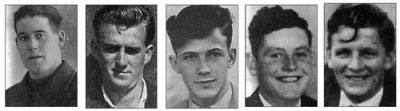
l-r Keegan, Parle, Smith, Craven, and Watters. Photo from An Phoblacht and Text from Edentubber 50th website.
Vol. Paul Smith
Adjutant Paul Smith from Bessbrook, Co. Armagh was the eldest of a family of seven.
An architects apprentice he was said to be of a happy and carefree nature, was widely and deeply read and had a flair for leadership and responsibility.
Slightly built he was described as being' as hard as iron' and had been involved in many daring missions.
For this the British and Stormont authorities had put a price on his head. Paul who had been away from home for over six months died aged 19 years.
Vol. George Keegan
George Keegan came from an impeccable tradition of separatism going back to to 1798. Born under the shadow of Enniscorthy's Vmegar Hill, a fact of which George was extremely proud, he came from a family with a deep rooted Republican tradition being a descendant of a rebel hanged in 1798.
His father Capt. Patrick Keegan was commandant of the North Wexford brigade of the Irish Republican Army during the Tan War (1919-21) and was in the Atheneum in Enniscorthy in 1916 when they were the last group in Ireland to surrender to the British forces.
In 1948 he was also involved in the 150th anniversary commemorations of 1798. His father before him was also involved and was arrested for being a Fenian organiser.
As boyhood friends of the young George, Mick Leary and Bob Kehoe have many fond memories. 'He was a genius in school with a great knowledge of history, dates and facts and was also very talented with his hands. Even as a schoolboy he was politically involved -launching an appeal to save the life of the 'Boy from Tralee', Vol. Charlie Kerins who was to be hanged by the Fianna Fail government in 1944. He was always very mature for his age, had a dry sense of humour and was very cheery going.
All his short life he was extremely popular and had no times for phonies." Mick and Bob continue: "George had great culinary skills too. Whenever his comrades in the Vmegar Hill column were billeted together, he was affectionately given the title 'cook-sergeant'. A baker by trade he was also known to poach the salmon." Through enigmatic in some ways', he was described by those who served with him as 'the ideal soldier perhaps more suited to Tom Barrys column of the Tan War and left an indelible impression on all around him.'
A single man he was last seen in Co. Wexford several weeks before his death at Edentubber, aged 29.
Vol. Paddy Parle
Paddy, from WIlliam St., Wexford town was a founding member of the Parnell G.A.A. Club. A worker in a local printing firm, he loved all things Irish, was a member of Conradh na Gaeilge and was a fluent Irish speaker, having secured a scholarship to Colaiste Charman, outside Gorey in his schooldays -a distinction of which he was very proud.
Paddy was born into a staunch labour family in Wexford in 1930. That influence led him to have a special regard for James Connolly and the working class cause.
He became an apprentice typesetter in the firm of John English and Co., Custom House Quay in the mid forties and remained there until his seven years were concluded. He also worked in Cahills of Dublin and spent a short period in England.
On returning to Wexford in the mid fifties he joined the local IRA. unit on the outbreak of the 'border campaign' and was largely instrumental in organising an active membership. Seven or eight Wexford men became part of the Vinegar Hill column and operated for a few months until arrests etc. put an end to their activities. Also the Chief of Staff of Oglaigh na hEireann of that period was of Wexford background and was fused with the '98 vision.
Paddy was described by a comrade, Labhras O'Donnghaile as the 'life and soul of the group on the border', was good humoured and lifted the spirits of those around him. During the years previous to volunteering for the campaign, he acted as 'Fear an Tl' at the many ceilithe held in the town hall and was a very popular character. Though devoted to the memory of Connolly, he was described by a comrade as being 'cut out in the mould of Pearse and acted out that role without realising it. Besides the cultural aspirations he was a deeply spiritual person and had not truck with vulgar talk etc. and was attentive to his religious upbringing.'
Bob and Mick recall his good humoured nature, cheering all the rest of them up and his flair for singing rebel songs. Bob recalls the last words heard from Paddy on that night in Edentubber -words that would ring prophetically, it was his favourite song, 'Padraig Pearses Farewell' -
'Farewell, farewell my lovely land farewell, When May dawn breaks, The last May I shall see ..." A single man he had been last seen by his brother, two months previously. Died aged 27.
Vol Oliver Craven
Oliver from Newry, Co. Armagh was a labourer and had been a driver before joining Oglaigh na hEireann.
Described as powerfully built and quietly spoken, he was particularly noted for his cool headedness.
On the run and wanted by the Stormont authorities, he had evaded capture several times.
Like the others, he read a lot in his spare time. Also, single, he had been away from home for almost six months and was only 19 when he died.
Michael Watters
Michael who owned the cottage where the bombs exploded was a forestry worker and had lived their alone since the death of his mother two years previously.
l-r Keegan, Parle, Smith, Craven, and Watters. Photo from An Phoblacht and Text from Edentubber 50th website.
Tuesday, November 5, 2013

Subscribe to:
Posts (Atom)